Saturday, November 24, 2007

IT'S DRIVING ME URBANE


When I was a student, we used to talk about what was going on in our souls. Now we make polite conversation. We used to "set the world to rights". Now anything of epic proportions is ventured tentatively, and to close friends only. To see if they're in the mood. We used to revel in exploring the mysteries of life and death and consciousness. We'd speculate wildly about radical schemes, and shout about love to the sky. Nothing was taboo. I know it was a bit strident sometimes, a bit direct and unhewn, but it was in some ways randomly philosophical. And I liked that. Now we're features journalists. Like Sunday magazine articles, each carefully hedged opinion is as unlikely to give offence as it is to raise a flicker of real excitement. I often find. I wonder what happened in the years in between. Did something change our minds?
END OF THE WORLD - BUT NOT IN HUNGARY

Saturday December 8th is the International Day of Climate Change Protests. It is, arguably, the most important protest in human history in that the issues concerned urgently affect us all, although doubtless it will come and go, and be forgotten. The latest IPCC Report warns starkly of "abrupt and irreversible changes" if nothing is done to reduce carbon emissions, and global leaders are meeting in Bali to cobble together whatever bland compromise they imagine their electorates can stomach.

We, the people, are gathering on the streets to urge them to go further, to let them know that we care about policy in this area, that we acknowledge the apocalyptic nature not only of the report, but of events occurring weekly in the News.

Although protests will take place in at least 83 countries, including Albania and Belarus, there is no action planned for Hungary. Presumably it will be isolated from the economic and social upheavals in the next decades by virtue of being well inland? I understand that people are dealing with seemingly more urgent and relevant problems here, but it is frustrating and bewildering that so few pay any interest at all in this era-defining issue that is ineluctably coming home to roost.

Global Climate Campaign

Saturday, November 03, 2007

MALAISE


I'm thrown from pillar to post
Don't know what I fear the most
My escape plans are littering the ground
Broken window where the world came in
Stomach-churning dose of vitamins
Will help me make the right constructive sounds

I feel I've lost control
Got a riot for a soul
And they're looking for somebody to kill
All their faces are mocking masks
As my decisions are disasters
And the procession is winding down the hill

There's nothing I've ever done
Made a difference to anyone
Of my deeds, there's little to record
Now the river has burst its banks
And all its filth has filled my tank
And its noise will drown my final words

Sunday, October 28, 2007

IN PRAISE OF KING CREOSOTE


As a songwriter, especially one going through a fallow period, you can tell immediately when someone else has just *got it*. The muse, the knack, the moment - whatever you want to call it. You don't get jealous or anything - you just listen and marvel. This year it's King Creosote. He's been producing material from his base in Fife for years now, but I don't know his back catalogue at all. The songs on his new album Bombshell are irresistably good, all of them. The lyrics are often from the heart and always to the point. They are original, often yearningly romantic, occasionally witty and with (refreshingly, in the days of Radiohead) no pretentiousness at all. The melodicism is effortless, so there's no need to surround it with sound effects. His voice, while often sailing off into falsetto, doesn't grate and is surprisingly rich. I like his musical principles too: "King Creosote maintains that the song is more important than the style, and that the performance outweighs recording quality. If a part can’t be recorded in one take, scrap it for something simpler." I reckon it might be the best album of 2007.

Some lyrics I liked from the last track:

"And your words chased round and round in my head last night
they chased their own tails
and your words jigged round my mind all night
to look at me now I'm quiet as sand
and the tide shrinks back into its womb
and I hope the empty shells and bones of your stories
will litter and clutter the shore
and I hope that when I find them
I'll remember how they danced
and the racket they made
when they were alive"

(c) King Creosote, 2007

King Creosote site
KC on Guardian Weekly podcast

Thursday, September 20, 2007

POSTSCRIPT: A QUESTION FOR SCHEDULERS

Since News editors feel they must feed viewers the daily gruel of "the" Business and "the" Sport - mostly any old thing they've dredged up, stories which are mind-altering in their elevation of the banal and irrelevant to headline material, perhaps they could find a slot for the Planet?

After all, if you think you can turn stock market movements into edge-of-the-seat stuff, why not try your hand at raising interest in the end of the world?

Here is today's News.

George Monbiot: the apocalypse, with sources

Climate Change Coming Home: The Guardian

To The End Of The Earth

Wednesday, September 19, 2007

WAKE UP CALL


I can't compose today. I feel too upset and actually disturbed about the unfolding events in Ghana and the rest of Africa, which was the main item on the BBC World Service news on Saturday. It's heightened by the fact I used to live there. Global warming is coming home, to stay. My friends and I *all* knew this was going to happen as long ago as 1987. Some dolphin crisis (as I remember) brought the Environment to the attention of the wider public and the Greens got 15% in the next UK European election.

Books were published. Artists caught on: "India under water, Africa - walking, What a scene of confusion, and the seas rising" - Julian Cope, Give Me Back My Flag, 1992. Climate change was in the new National Curriculum in 1992. And the kids sent their paper leaves with their thoughts on to the Rio Earth Summit. Hopes were high.

I kept saying over and over that the impending crisis ought to be on all the front pages and in all TV News bulletins every day. Of course, the media let us down, and they are still doing so. What's on CNN today? Interest rates and, just like in 1995, O.J. fucking Simpson! They haven't even run the Africa story yet; probably because the journalists can't or won't get into the disaster zones to take pictures.

Most Ghanaians are deeply religious, open-hearted, resilient people. It's another "land of smiles". Against all the odds, they persevere in their steady faith and optimism. And they have an engaging sense of humour and of the absurd: they know the odds are stacked against them. And now the fields lie flooded, and hundreds of thousands are displaced, their rickety mud and straw huts washed away. The outlook is bleaker - food shortages because of the drowned crops; increased occurrence of malaria; cholera; even locusts, to make it truly Biblical. (To echo John Humphrys, where was God?)

BBC NEWS: Africans' responses

We all let them down. But most of all, the politicians, who should have known much better, let them down. For twenty years they have soldiered on in the vain pursuit of economic growth at all costs - full steam ahead. And if that were not enough, they planned wars to guarantee that precious oil supply, which unsettled the whole Middle East. Ignoring the Environment and huge disparities of wealth, they are directly to blame for the "Terror" we hear so much about now. How different things might have been if they had thought to invest heavily in renewable energy in the 90s, or bring in "carbon credits", which I first heard about around the same time. Apart from Prince Charles, Al Gore's was the only prominent voice I heard promoting green issues, but even he did little at Kyoto and was strangely silent about the Big E during his Presidential bid in 2000, splitting the Green vote, and consequently losing California. And we all know what happened next. Cheers for the great movie, Al - I've almost forgiven you.

In December, these politicians are assembling for yet another expenses-paid international talking shop. This time they had better act and bring in some of those mythical "tough targets". Because if we fail to keep the temperature increase below 2 degrees, all Hell will break loose. Not just for the poor Africans, either - the security implications will threaten everyone's comfortable lifestyle.

We have a global village, and the internet is amazing. People in huge numbers support Green issues. And - shock! - would vote for them. I have that much faith left in people. And there's no dearth of ideas. People in the public eye only need to speak up. Imagine if we had a Green alternative to vote for, for example. How hard would it be for Brown, Cameron or any of those Presidential hopefuls to cobble that together? And CNN - How hard would it be to follow the BBC World Service's lead and "front" (or just run) the story, the one which is the underlying and compelling narrative of our times?

Sunday, September 02, 2007

SOME TIME IN TIMISOARA

I arrived in Timisoara thinking it would be more or less a den of thieves, and worried about being conspicuously Western (even though my three years in Budapest ought to mean I've become "Central") and the rickety railway station, with a few down-on-their-luck-looking characters hanging about, confirmed my prejudice that I was now in the Wild East.

Admittedly, the train journey wasn't fun, as I had to fight a particularly grumpy Hungarian woman for the privilege to open the window, which she immediately closed, then, seeing I wasn't about to give way, proceeded to scowl and sigh about, casting exasperated glances to win support from our fellow compartmentees. They all looked sullen and ugly - probably I did too - and I'd been warned not too fall asleep in case I lost all my belongings. But doze off I - inevitably - did. Luckily, all my stuff was present and correct on waking. The countyside as you cross the border is particularly grim-looking; a chemical pipeling, miles long with the lagging peeling away goes right through people's gardens below head height. You notice that all the buildings are either depressing blocks with the paint peeling, or else industrial plants.

So much for (what I saw of) the countryside. Timosoara is different altogether. In the centre are impressive squares, the prettiest of which is cobbled and surrounded by the usual kind of Imperial buildings in the style of Christmas cards, with geometric arched facades painted in pastel colours, and high-angled rooftops. Many are in a state of advanced decrepitude, some still cratered by war, but the elegance stubbornly remains. Much of the square itself is now shaded by the parasols of terrace cafes. Here, the waitresses carefully squirt dilute blue detergent on to the paper tissue placed in each ash tray.

What surprised me the most was the amount of wealth here. Of course, leaving the centre, there are the usual Communist blocks which a few of the owners have beautified with flowers on the balconies. (Flowers are really popular here - a large section of the central market is given over to dozens of flower stalls.) Just beyond, it was easy to locate the enormous Julius Mall, which dwarfs the buildings around it. With four floors, it's the biggest I've seen, a mall-as-city on an American scale. And it's busy. People are drinking beer and coffee (at inflated prices) in the perimeter cafes, and the car park is full of cars. While I drank my beer, four wedding parties went in - is there a registry office in there, perhaps, or are they just topping up on flowers? The cutomers are mostly loaded with the expected plastic bags, and everyone is sporting sunglasses and clothes in the latest styles (long shorts, short tops, etc) - including the children. It doesn't look like a poor country from where I'm sitting.

A final mystery is the rich Roma families. No one quite knows how they get their money. I was told "don't ask", but I did, and the stories you get are uniformly nasty - it's begging, at best, or selling their children in the West. Well, I once saw a Roma woman in Budapest doing the hard-sell with pairs of socks in Budapest - this wouldn't be enough to fund the kind of palaces these families are building near my school. These are ostentatious, in the very grandest of styles - conical pinnacles of towers, balconies with pillars, often roughly finished. They're similar to the Western mock-gothic, except with a definite Oriental twist that makes me think of the Arabian Nights and the Golden Horde. (My architectural vocabulary isn't wide enough to do them justice; I'd call them "Sultanic".) Everyone says they're tasteless, but the cones and pinnacles aren't so different to my eyes from those of the magnificent Orthodox cathedral in the town centre.


Some of these buildings could fuel urban vampre fantasies. I bought a bottle of Transylvanian "V" wine. With a drop of blood dripping from the logo, it boasted the fact that it was made from the "grapes of immortality". In small print underneath, it turned out that V drinks are a company from that well-known haunt of the undead, Cardiff!

Thursday, July 26, 2007

TOUR DE FRANCE

What a bloody fuss about nothing! I heard someone say that doping should be made a criminal offence. Why? Let them all take as many drugs as they want if it makes them go faster, which is the whole point of the thing - or did I miss something? Far from being the end of the TdF, it could usher in a new era of performance-enhanced sport which might be slightly less tedious to watch on TV. Next item, please...

Saturday, July 21, 2007

FEEL THE HEAT

As I type, the fan is hissing away in the corner, making some currents in the air. Because they carry a little of the cool of morning, these are welcome relief from the heatwave. My shutters are closed to preserve what’s left. Outside, at 9am, it’s already 27 degrees and in the day temperatures have soared to 42 degrees in the shade. This means that most fans feel like hair-driers, and you start to go a little crazy. You’d give your entire salary for the week for a big, cool slice of watermelon; luckily, these are so plentiful that they’re almost giving them away. The other day, I went for an ice coffee but the outdoor cafĂ© was deserted; it was too hot, even under the parasols. Nearby, people were standing fully clothed under some kind of sprinkler system.

All round the city, various stinks have been let loose: foul-sweet decay, a mild smell of sewage and something fungal. The sources of these are obscure, buried somewhere. If I arrive home without having done all the dishes and wiped all the surfaces spotless, there will be an army of ants massing on every wooden spoon and missed drop of fruit juice. It's the kind of weather to listen to Crosby, Stills & Nash. Or have a cold shower and then dry off in front of a fan.

Thursday, June 14, 2007

CIVILISATION & DEVELOPMENT

"Sometimes we wonder... when you look at the developed world, whether there is in fact an advancement in terms of civilisation or whether there has been a de-civilisation. Because civilisation has to do with the development of the human individual, the mind, the finer aspects of humanity, and I think those are lost."

Jigmi Thinley, Home & Cultural Affairs Minister, Bhutan on The Happiness Formula, BBC World

Thursday, May 31, 2007

FRANK HISTORY

Not so much lost in translation, as added to. Found in a historical brochure about Tihany, beautiful hilltop town overlooking Lake Balaton. "The name (Pale Hill)...goes back to the time when the soldiers of the fortress impaled the Turks who abducted Hungarian women and screwed the peasantry."
40
Happy Birthday Sgt Pepper. I remember buying it at 12 years old, and listening to it in some altered states a few years later. Possibly it doesn't deserve all the admiration heaped on it originally, I don't know. (It's so familiar now, it's hard to be objective.) Who cares? I say forget the "cultural turning point" stuff. Get a good (CD) version. Put it on - headphones. Turn the volume up. Listen to the actual band, especially the bass lines (Getting Better, Lucy in The Sky...) It's good. Oh, and it was made on a 4-track tape recorder too...

http://entertainment.timesonline.co.uk/tol/arts_and_entertainment/music/article1873290.ece

Saturday, May 12, 2007

VICIOUS

It is inevitable that anyone in the political arena meets their nemesis, falters and ultimately fails - in my lifetime, I remember the fall of Gorbachev and Thatcher in particular. I'm not going to add to the commentary on Blair's legacy now; I still think broadly what I said on this blog in June 2006, that his career is tragic in some ways. (Though, of course, he's made a lot of money etc. Not the point!)

What has shocked me is the comments of members of the public on sites like BBC News and The Times Online. They are not just uncharitable, but full of a visceral hatred for Blair. "May he rot in Hell" etc. Of course he has made mistakes, perhaps based on serious character flaws - but would it be possible to hold power for a decade and get everything right? I really don't understand why he evinces such unrestrained vituperation from people who once (surely) cheered him on. It's an eerie, actually frightening, manifestation of the fickle mob in Julius Caesar.

I have less of a problem with people who have disliked Blair all along!

On a lighter note: evinces violent, vicious, venomous, vituperative, vengeful, visceral hatred. And V for Vendetta.

Thursday, May 10, 2007

CLEAR AND PRESENT DANGER

World expenditure on military research and development in 2005: $1,118 BILLION

Source: Beyond Terror (Chris Abbott, Paul Rogers & John Sloboda, 2007) I recommend this book for anyone interested in the roots of current world crises. It describes very elegantly (100 pages) how competition for resources and the terrorist threat are inextricably linked, as well as providing an alternative blueprint for future development. The money is clearly available for alternative technologies (see above!) All that is lacking is the political will. Where are the politicians who are prepared to stick their necks out, and face up to the real threats?

Wednesday, May 09, 2007

EXULTESCENCE?

Tomorrow's my birthday, and I will be at the very extreme of being "thirty something". Life's good, but it's been missing certain things. In some cases, I have no idea whether these are good things or bad things to lack.

Broken River by Ruary Allan, Art Alchemist

1. I've never been engaged, married, or owned property.
2. I've never owned a car, or driven to work. In fact, I've never commuted to work in a commuter train either, in the sense of packing myself in, reading Metro and wishing it would all go away. I once did a reverse commute for a couple of years. When the weather's warm, I cycle to work now.
3. I've never been to Ikea, or bought furniture from Habitat. I once had a friend help me put up some shelves in the early 90s. It was good to see all my books (which are now lost to me - in eternal storage) but it didn't make me into a DIY enthusiast.
4. As an adult, I've never believed fully in any "ism"s. Buddhism has a strong appeal, but I'm not very good at it, and I stop short at myths of reincarnation, gods and demons.
5. I have never really had anyone to vote for in the sense that a radical green alternative has never been available. I remember shaking Blair's hand on that sunny morning in Downing Street (May 2 1997) but his record means that I will never again believe promises of change from young, gifted politicians.
6. Finally, although I appreciate clever art (most recently in some of the witty prose in Gormenghast) I'm still more into directness than sophistication, especially in real life.

Mandala by Olyfka Brabcova

I was sent this quotation today. It's Kenneth Graeme talking about children: "their simple acceptance of the mood of wonderment, their readiness to welcome a perfect miracle at any hour of the day or night, is a thing more precious than any of the laboured acquisition of adult mankind." Is this something you inevitably lose? It seems like a good way to live. Every time I leave my flat and the outside air hits my face, I exult in the sensation.

Weltschmerzen? Manchmal, aber:
"...it's hard to stay mad, when there's so much beauty in the world. Sometimes I feel like I'm seeing it all at once, and it's too much, my heart fills up like a balloon that's about to burst... And then I remember to relax, and stop trying to hold on to it, and then it flows through me like rain and I can't feel anything but gratitude for every single moment of my stupid little life... You have no idea what I'm talking about, I'm sure. But don't worry... you will someday." Lester Burnham in American Beauty.

Sunday, May 06, 2007

SECOND-HAND BOOK SHOPPING

Every Saturday morning, almost without fail, I go to the market to buy food for the week. Yesterday when a friend texted me about meeting up instead, it felt great to break with routine and swap the usual vegetable run for a bit of book browsing and a pub lunch. It was the first time I'd been to Red Bus Books, Budapest's biggest second-hand shop for books in English. The place has the unmistakable smell you always get in second-hand bookshops, and a tangible sense of unhurriedness. As well as Gormenghast, the second of the Mervyn Peake trilogy, I picked up Bobby Kennedy's memoirs of the Cuban Missile Crisis and a 1969 edition of The Souls of Black Folk by WEB Du Bois, a seminal text of what was to become the civil rights movement, about the experience of Afro-Americans at the turn of the 20th Century. In a new bookshop I'd never have looked for these. It's this prospect of stumbling across something unexpectedly that is the point of second-hand shops, and also of routine-breaking.
PRUNESQUALLOR

In Titus Groan, Dr Prunesquallor is a perceptive character, one with which the reader eventually identifies as he is the only one with a true sense of perspective on his world, something he is careful to mask with florid but empty pronouncements. In this scene, he encounters the scheming and Machiavellian Steerpike, a former kitchen servent who has recently absconded.
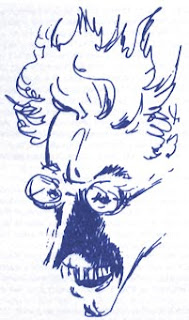
"Am I mistaken, dear boy, or is that a kitchen jacket you're wearing?"

"Not only is this a kitchen jacket, but these are kitchen trousers and kitchen socks and kitchen shoes and everything is kitchen about me, sir, except myself, if you don't mind me saying so, Doctor."

"And what," said Prunesquallor, placing the tips of his fingers together, "are you? Beneath your foetid jacket, which I must say looks amazingly unhygienic even for Swelter's kitchen. What are you? Are you a problem case, my dear boy, or are you a clear-cut young gentleman with no ideas at all, ha, ha, ha?"

"With your permission, Doctor, I am neither. I have plenty of ideas, though at the moment plenty of problems, too."

"Is that so?" said the Doctor. "Is that so? How very unique! Have your brandy first and perhaps some of them will fade gently away upon the fumes of that very excellent narcotic. Ha, ha, ha! Fade gently and imperceptibly away..." And he fluttered his long fingers in the air.

...

"Steerpike," said the youth. "My name is Steerpike, sir."

"Steerpike of the Many Problems," said the Doctor. "What did you say they were? My memory is so very untrustworthy. It's as fickle as a fox. Ask me to name the third lateral blood vessel from the extremity of my index finger that runs east to west when I lie on my face at sundown, or the percentage of chalk to be found in the knuckes of an average spinster in her fifty-seventh year, ha, ha, ha! - Or even ask me, my dear boy, to give details of the pulse rate of frogs two minutes before they die of scabies - these things are no tax upon my memory, ha, ha, ha! but ask me to remember exactly what you said your problems were a minute ago, and you will find that my memory has forsaken me utterly. Now, why is that, my dear Master Steerpike, why is that?"

"Because I never mentioned them," said Steerpike.

"That accounts for it," said Prunesquallor. "That, no doubt, accounts for it."
DICKENS IN A CASTLE


I have just finished reading Titus Groan by Mervyn Peake. It’s been a great read, and I wonder why it took me so many years to get round to it. I saw an excellent stage adaptation in the mid-90s and that was enough gothic fantasy at the time, but of course I reckoned without Peake’s beautiful, elaborate – occasionally overwrought – prose style, in which words like “adumbrate” and “umbrageous” sit comfortably, and which is perfectly suited to describing the world of Gormenghast.

Pre-dating the first of the Lord Of The Rings books by two years, Titus Groan introduces the reader to a world as perfectly realised as Tolkien’s, full of colour and populated by unforgettably spiky characters, but thankfully free of elves and magic. The castle itself looms over its world, its occupants with their internal monologues and power struggles being the focus of the action. It is a place bound by calcified ritual and forms the backdrop to all the important scenes. Peake himself seems to be held in its spell; when his narrative occasionally wanders away from Gormenghast, it becomes far less compelling and much more the stuff of a more ordinary fantasy.

The best part of the book is the animation of the characters. A vein of dark humour permeates the pages as the author hones their idiosyncracies, like one of his own “Bright Carvers” - every twitch, stride and thought process is catalogued in detail. Their names are equally evocative: Sepulchrave, Dr Prunesquallor, Fuchsia, Swelter, Flay. Imagine Dickens set in a castle.

Like Dickens, Peake experiments with a variety of prose and narrative style. For example, when he portrays the same event from the point of view of all the characters present, or the half page devoted to the description of a raindrop trickling down a leaf. There are so many passages I could quote. The teenager Fuchsia’s love for her attic space (with echoes of Yeats’s Long-Legged Fly, perhaps) is beautifully captured here.

“As Fuchsia climbed into the winding darkness her body was impregnated and made faint by a qualm as of green April. Her heart beat painfully.

There is a love that equals in its power the love of man for woman and reaches inward as deeply. It is the love of a man or a woman for their world. For the world of their centre where their lives burn genuinely and with a free flame.

The love of the diver for his world of wavering light. His world of pearls and tendrils and his breath at his breast… The love of a painter standing alone and staring, staring at the great coloured surface he is making. Standing with him in the room the rearing canvas stares back with tentative shapes halted in their growth, moving in a new rhythm from floor to ceiling. The twisted tubes, the fresh paint squeezed and smeared across the dry upon his palette. The dust beneath the easel. The paint has edged along the brushes’ handles. The white light in a northern sky is silent. The window gapes as he inhales his world. His world: a rented room, and turpentine. He moves towards his half-born. He is in love.”

Gormenghast home page

Sunday, March 04, 2007

IS IT A TARDIS?


People sometimes point out that phone boxes are obsolete. So I thought I'd preserve this futuristic Swiss phone box here. Along with sleek shower-heads, windows that open two ways, self-cleaning garlic crushers, symmetrical door keys (so you can't insert them upside-down) and the omnipresent multi-blade penknives, it's a design classic. Oh, of course it's graffiti- and urine-free, and hasn't been smashed up. What do Swiss teenagers find to do in the evenings?
HELLO SPRING

This was taken on 4 February. But now it's March and I'm more in the mood.