 Not so much lost in translation, as added to. Found in a historical brochure about Tihany, beautiful hilltop town overlooking Lake Balaton. "The name (Pale Hill)...goes back to the time when the soldiers of the fortress impaled the Turks who abducted Hungarian women and screwed the peasantry."
Thursday, May 31, 2007
FRANK HISTORY
 Not so much lost in translation, as added to. Found in a historical brochure about Tihany, beautiful hilltop town overlooking Lake Balaton. "The name (Pale Hill)...goes back to the time when the soldiers of the fortress impaled the Turks who abducted Hungarian women and screwed the peasantry."
Not so much lost in translation, as added to. Found in a historical brochure about Tihany, beautiful hilltop town overlooking Lake Balaton. "The name (Pale Hill)...goes back to the time when the soldiers of the fortress impaled the Turks who abducted Hungarian women and screwed the peasantry."

40
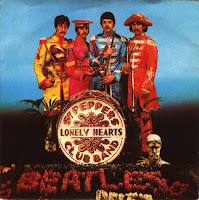 Happy Birthday Sgt Pepper. I remember buying it at 12 years old, and listening to it in some altered states a few years later. Possibly it doesn't deserve all the admiration heaped on it originally, I don't know. (It's so familiar now, it's hard to be objective.) Who cares? I say forget the "cultural turning point" stuff. Get a good (CD) version. Put it on - headphones. Turn the volume up. Listen to the actual band, especially the bass lines (Getting Better, Lucy in The Sky...) It's good. Oh, and it was made on a 4-track tape recorder too...
http://entertainment.timesonline.co.uk/tol/arts_and_entertainment/music/article1873290.ece
 Happy Birthday Sgt Pepper. I remember buying it at 12 years old, and listening to it in some altered states a few years later. Possibly it doesn't deserve all the admiration heaped on it originally, I don't know. (It's so familiar now, it's hard to be objective.) Who cares? I say forget the "cultural turning point" stuff. Get a good (CD) version. Put it on - headphones. Turn the volume up. Listen to the actual band, especially the bass lines (Getting Better, Lucy in The Sky...) It's good. Oh, and it was made on a 4-track tape recorder too...
http://entertainment.timesonline.co.uk/tol/arts_and_entertainment/music/article1873290.ece
Saturday, May 12, 2007
VICIOUS
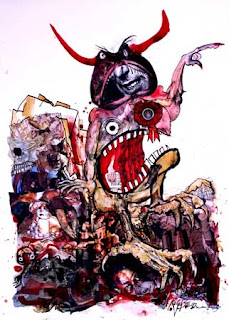 It is inevitable that anyone in the political arena meets their nemesis, falters and ultimately fails - in my lifetime, I remember the fall of Gorbachev and Thatcher in particular. I'm not going to add to the commentary on Blair's legacy now; I still think broadly what I said on this blog in June 2006, that his career is tragic in some ways. (Though, of course, he's made a lot of money etc. Not the point!)
What has shocked me is the comments of members of the public on sites like BBC News and The Times Online. They are not just uncharitable, but full of a visceral hatred for Blair. "May he rot in Hell" etc. Of course he has made mistakes, perhaps based on serious character flaws - but would it be possible to hold power for a decade and get everything right? I really don't understand why he evinces such unrestrained vituperation from people who once (surely) cheered him on. It's an eerie, actually frightening, manifestation of the fickle mob in Julius Caesar.
I have less of a problem with people who have disliked Blair all along!
On a lighter note: evinces violent, vicious, venomous, vituperative, vengeful, visceral hatred. And V for Vendetta.
 It is inevitable that anyone in the political arena meets their nemesis, falters and ultimately fails - in my lifetime, I remember the fall of Gorbachev and Thatcher in particular. I'm not going to add to the commentary on Blair's legacy now; I still think broadly what I said on this blog in June 2006, that his career is tragic in some ways. (Though, of course, he's made a lot of money etc. Not the point!)
What has shocked me is the comments of members of the public on sites like BBC News and The Times Online. They are not just uncharitable, but full of a visceral hatred for Blair. "May he rot in Hell" etc. Of course he has made mistakes, perhaps based on serious character flaws - but would it be possible to hold power for a decade and get everything right? I really don't understand why he evinces such unrestrained vituperation from people who once (surely) cheered him on. It's an eerie, actually frightening, manifestation of the fickle mob in Julius Caesar.
I have less of a problem with people who have disliked Blair all along!
On a lighter note: evinces violent, vicious, venomous, vituperative, vengeful, visceral hatred. And V for Vendetta.
Thursday, May 10, 2007
CLEAR AND PRESENT DANGER
World expenditure on military research and development in 2005: $1,118 BILLION
 Source: Beyond Terror (Chris Abbott, Paul Rogers & John Sloboda, 2007) I recommend this book for anyone interested in the roots of current world crises. It describes very elegantly (100 pages) how competition for resources and the terrorist threat are inextricably linked, as well as providing an alternative blueprint for future development. The money is clearly available for alternative technologies (see above!) All that is lacking is the political will. Where are the politicians who are prepared to stick their necks out, and face up to the real threats?
World expenditure on military research and development in 2005: $1,118 BILLION
 Source: Beyond Terror (Chris Abbott, Paul Rogers & John Sloboda, 2007) I recommend this book for anyone interested in the roots of current world crises. It describes very elegantly (100 pages) how competition for resources and the terrorist threat are inextricably linked, as well as providing an alternative blueprint for future development. The money is clearly available for alternative technologies (see above!) All that is lacking is the political will. Where are the politicians who are prepared to stick their necks out, and face up to the real threats?
Wednesday, May 09, 2007
EXULTESCENCE?
Tomorrow's my birthday, and I will be at the very extreme of being "thirty something". Life's good, but it's been missing certain things. In some cases, I have no idea whether these are good things or bad things to lack.
 Broken River by Ruary Allan, Art Alchemist
1. I've never been engaged, married, or owned property.
2. I've never owned a car, or driven to work. In fact, I've never commuted to work in a commuter train either, in the sense of packing myself in, reading Metro and wishing it would all go away. I once did a reverse commute for a couple of years. When the weather's warm, I cycle to work now.
3. I've never been to Ikea, or bought furniture from Habitat. I once had a friend help me put up some shelves in the early 90s. It was good to see all my books (which are now lost to me - in eternal storage) but it didn't make me into a DIY enthusiast.
4. As an adult, I've never believed fully in any "ism"s. Buddhism has a strong appeal, but I'm not very good at it, and I stop short at myths of reincarnation, gods and demons.
5. I have never really had anyone to vote for in the sense that a radical green alternative has never been available. I remember shaking Blair's hand on that sunny morning in Downing Street (May 2 1997) but his record means that I will never again believe promises of change from young, gifted politicians.
6. Finally, although I appreciate clever art (most recently in some of the witty prose in Gormenghast) I'm still more into directness than sophistication, especially in real life.
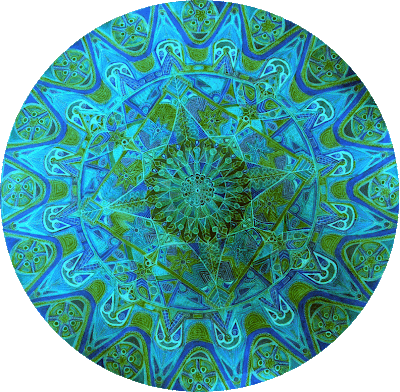 Mandala by Olyfka Brabcova
I was sent this quotation today. It's Kenneth Graeme talking about children: "their simple acceptance of the mood of wonderment, their readiness to welcome a perfect miracle at any hour of the day or night, is a thing more precious than any of the laboured acquisition of adult mankind." Is this something you inevitably lose? It seems like a good way to live. Every time I leave my flat and the outside air hits my face, I exult in the sensation.
Weltschmerzen? Manchmal, aber:
"...it's hard to stay mad, when there's so much beauty in the world. Sometimes I feel like I'm seeing it all at once, and it's too much, my heart fills up like a balloon that's about to burst... And then I remember to relax, and stop trying to hold on to it, and then it flows through me like rain and I can't feel anything but gratitude for every single moment of my stupid little life... You have no idea what I'm talking about, I'm sure. But don't worry... you will someday." Lester Burnham in American Beauty.
Tomorrow's my birthday, and I will be at the very extreme of being "thirty something". Life's good, but it's been missing certain things. In some cases, I have no idea whether these are good things or bad things to lack.
 Broken River by Ruary Allan, Art Alchemist
1. I've never been engaged, married, or owned property.
2. I've never owned a car, or driven to work. In fact, I've never commuted to work in a commuter train either, in the sense of packing myself in, reading Metro and wishing it would all go away. I once did a reverse commute for a couple of years. When the weather's warm, I cycle to work now.
3. I've never been to Ikea, or bought furniture from Habitat. I once had a friend help me put up some shelves in the early 90s. It was good to see all my books (which are now lost to me - in eternal storage) but it didn't make me into a DIY enthusiast.
4. As an adult, I've never believed fully in any "ism"s. Buddhism has a strong appeal, but I'm not very good at it, and I stop short at myths of reincarnation, gods and demons.
5. I have never really had anyone to vote for in the sense that a radical green alternative has never been available. I remember shaking Blair's hand on that sunny morning in Downing Street (May 2 1997) but his record means that I will never again believe promises of change from young, gifted politicians.
6. Finally, although I appreciate clever art (most recently in some of the witty prose in Gormenghast) I'm still more into directness than sophistication, especially in real life.
 Mandala by Olyfka Brabcova
I was sent this quotation today. It's Kenneth Graeme talking about children: "their simple acceptance of the mood of wonderment, their readiness to welcome a perfect miracle at any hour of the day or night, is a thing more precious than any of the laboured acquisition of adult mankind." Is this something you inevitably lose? It seems like a good way to live. Every time I leave my flat and the outside air hits my face, I exult in the sensation.
Weltschmerzen? Manchmal, aber:
"...it's hard to stay mad, when there's so much beauty in the world. Sometimes I feel like I'm seeing it all at once, and it's too much, my heart fills up like a balloon that's about to burst... And then I remember to relax, and stop trying to hold on to it, and then it flows through me like rain and I can't feel anything but gratitude for every single moment of my stupid little life... You have no idea what I'm talking about, I'm sure. But don't worry... you will someday." Lester Burnham in American Beauty.
Sunday, May 06, 2007
SECOND-HAND BOOK SHOPPING
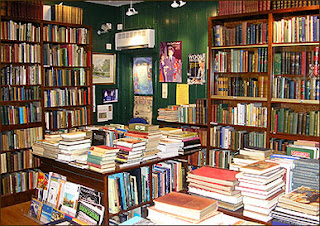 Every Saturday morning, almost without fail, I go to the market to buy food for the week. Yesterday when a friend texted me about meeting up instead, it felt great to break with routine and swap the usual vegetable run for a bit of book browsing and a pub lunch. It was the first time I'd been to Red Bus Books, Budapest's biggest second-hand shop for books in English. The place has the unmistakable smell you always get in second-hand bookshops, and a tangible sense of unhurriedness. As well as Gormenghast, the second of the Mervyn Peake trilogy, I picked up Bobby Kennedy's memoirs of the Cuban Missile Crisis and a 1969 edition of The Souls of Black Folk by WEB Du Bois, a seminal text of what was to become the civil rights movement, about the experience of Afro-Americans at the turn of the 20th Century. In a new bookshop I'd never have looked for these. It's this prospect of stumbling across something unexpectedly that is the point of second-hand shops, and also of routine-breaking.
 Every Saturday morning, almost without fail, I go to the market to buy food for the week. Yesterday when a friend texted me about meeting up instead, it felt great to break with routine and swap the usual vegetable run for a bit of book browsing and a pub lunch. It was the first time I'd been to Red Bus Books, Budapest's biggest second-hand shop for books in English. The place has the unmistakable smell you always get in second-hand bookshops, and a tangible sense of unhurriedness. As well as Gormenghast, the second of the Mervyn Peake trilogy, I picked up Bobby Kennedy's memoirs of the Cuban Missile Crisis and a 1969 edition of The Souls of Black Folk by WEB Du Bois, a seminal text of what was to become the civil rights movement, about the experience of Afro-Americans at the turn of the 20th Century. In a new bookshop I'd never have looked for these. It's this prospect of stumbling across something unexpectedly that is the point of second-hand shops, and also of routine-breaking.
PRUNESQUALLOR
In Titus Groan, Dr Prunesquallor is a perceptive character, one with which the reader eventually identifies as he is the only one with a true sense of perspective on his world, something he is careful to mask with florid but empty pronouncements. In this scene, he encounters the scheming and Machiavellian Steerpike, a former kitchen servent who has recently absconded.
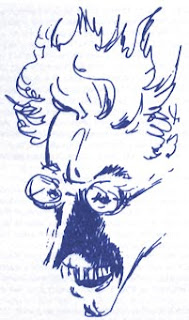 "Am I mistaken, dear boy, or is that a kitchen jacket you're wearing?"
"Not only is this a kitchen jacket, but these are kitchen trousers and kitchen socks and kitchen shoes and everything is kitchen about me, sir, except myself, if you don't mind me saying so, Doctor."
"And what," said Prunesquallor, placing the tips of his fingers together, "are you? Beneath your foetid jacket, which I must say looks amazingly unhygienic even for Swelter's kitchen. What are you? Are you a problem case, my dear boy, or are you a clear-cut young gentleman with no ideas at all, ha, ha, ha?"
"With your permission, Doctor, I am neither. I have plenty of ideas, though at the moment plenty of problems, too."
"Is that so?" said the Doctor. "Is that so? How very unique! Have your brandy first and perhaps some of them will fade gently away upon the fumes of that very excellent narcotic. Ha, ha, ha! Fade gently and imperceptibly away..." And he fluttered his long fingers in the air.
...
"Steerpike," said the youth. "My name is Steerpike, sir."
"Steerpike of the Many Problems," said the Doctor. "What did you say they were? My memory is so very untrustworthy. It's as fickle as a fox. Ask me to name the third lateral blood vessel from the extremity of my index finger that runs east to west when I lie on my face at sundown, or the percentage of chalk to be found in the knuckes of an average spinster in her fifty-seventh year, ha, ha, ha! - Or even ask me, my dear boy, to give details of the pulse rate of frogs two minutes before they die of scabies - these things are no tax upon my memory, ha, ha, ha! but ask me to remember exactly what you said your problems were a minute ago, and you will find that my memory has forsaken me utterly. Now, why is that, my dear Master Steerpike, why is that?"
"Because I never mentioned them," said Steerpike.
"That accounts for it," said Prunesquallor. "That, no doubt, accounts for it."
In Titus Groan, Dr Prunesquallor is a perceptive character, one with which the reader eventually identifies as he is the only one with a true sense of perspective on his world, something he is careful to mask with florid but empty pronouncements. In this scene, he encounters the scheming and Machiavellian Steerpike, a former kitchen servent who has recently absconded.
 "Am I mistaken, dear boy, or is that a kitchen jacket you're wearing?"
"Not only is this a kitchen jacket, but these are kitchen trousers and kitchen socks and kitchen shoes and everything is kitchen about me, sir, except myself, if you don't mind me saying so, Doctor."
"And what," said Prunesquallor, placing the tips of his fingers together, "are you? Beneath your foetid jacket, which I must say looks amazingly unhygienic even for Swelter's kitchen. What are you? Are you a problem case, my dear boy, or are you a clear-cut young gentleman with no ideas at all, ha, ha, ha?"
"With your permission, Doctor, I am neither. I have plenty of ideas, though at the moment plenty of problems, too."
"Is that so?" said the Doctor. "Is that so? How very unique! Have your brandy first and perhaps some of them will fade gently away upon the fumes of that very excellent narcotic. Ha, ha, ha! Fade gently and imperceptibly away..." And he fluttered his long fingers in the air.
...
"Steerpike," said the youth. "My name is Steerpike, sir."
"Steerpike of the Many Problems," said the Doctor. "What did you say they were? My memory is so very untrustworthy. It's as fickle as a fox. Ask me to name the third lateral blood vessel from the extremity of my index finger that runs east to west when I lie on my face at sundown, or the percentage of chalk to be found in the knuckes of an average spinster in her fifty-seventh year, ha, ha, ha! - Or even ask me, my dear boy, to give details of the pulse rate of frogs two minutes before they die of scabies - these things are no tax upon my memory, ha, ha, ha! but ask me to remember exactly what you said your problems were a minute ago, and you will find that my memory has forsaken me utterly. Now, why is that, my dear Master Steerpike, why is that?"
"Because I never mentioned them," said Steerpike.
"That accounts for it," said Prunesquallor. "That, no doubt, accounts for it."
DICKENS IN A CASTLE

I have just finished reading Titus Groan by Mervyn Peake. It’s been a great read, and I wonder why it took me so many years to get round to it. I saw an excellent stage adaptation in the mid-90s and that was enough gothic fantasy at the time, but of course I reckoned without Peake’s beautiful, elaborate – occasionally overwrought – prose style, in which words like “adumbrate” and “umbrageous” sit comfortably, and which is perfectly suited to describing the world of Gormenghast.
Pre-dating the first of the Lord Of The Rings books by two years, Titus Groan introduces the reader to a world as perfectly realised as Tolkien’s, full of colour and populated by unforgettably spiky characters, but thankfully free of elves and magic. The castle itself looms over its world, its occupants with their internal monologues and power struggles being the focus of the action. It is a place bound by calcified ritual and forms the backdrop to all the important scenes. Peake himself seems to be held in its spell; when his narrative occasionally wanders away from Gormenghast, it becomes far less compelling and much more the stuff of a more ordinary fantasy.
The best part of the book is the animation of the characters. A vein of dark humour permeates the pages as the author hones their idiosyncracies, like one of his own “Bright Carvers” - every twitch, stride and thought process is catalogued in detail. Their names are equally evocative: Sepulchrave, Dr Prunesquallor, Fuchsia, Swelter, Flay. Imagine Dickens set in a castle.
Like Dickens, Peake experiments with a variety of prose and narrative style. For example, when he portrays the same event from the point of view of all the characters present, or the half page devoted to the description of a raindrop trickling down a leaf. There are so many passages I could quote. The teenager Fuchsia’s love for her attic space (with echoes of Yeats’s Long-Legged Fly, perhaps) is beautifully captured here.
“As Fuchsia climbed into the winding darkness her body was impregnated and made faint by a qualm as of green April. Her heart beat painfully.
There is a love that equals in its power the love of man for woman and reaches inward as deeply. It is the love of a man or a woman for their world. For the world of their centre where their lives burn genuinely and with a free flame.
The love of the diver for his world of wavering light. His world of pearls and tendrils and his breath at his breast… The love of a painter standing alone and staring, staring at the great coloured surface he is making. Standing with him in the room the rearing canvas stares back with tentative shapes halted in their growth, moving in a new rhythm from floor to ceiling. The twisted tubes, the fresh paint squeezed and smeared across the dry upon his palette. The dust beneath the easel. The paint has edged along the brushes’ handles. The white light in a northern sky is silent. The window gapes as he inhales his world. His world: a rented room, and turpentine. He moves towards his half-born. He is in love.”
Gormenghast home page

I have just finished reading Titus Groan by Mervyn Peake. It’s been a great read, and I wonder why it took me so many years to get round to it. I saw an excellent stage adaptation in the mid-90s and that was enough gothic fantasy at the time, but of course I reckoned without Peake’s beautiful, elaborate – occasionally overwrought – prose style, in which words like “adumbrate” and “umbrageous” sit comfortably, and which is perfectly suited to describing the world of Gormenghast.
Pre-dating the first of the Lord Of The Rings books by two years, Titus Groan introduces the reader to a world as perfectly realised as Tolkien’s, full of colour and populated by unforgettably spiky characters, but thankfully free of elves and magic. The castle itself looms over its world, its occupants with their internal monologues and power struggles being the focus of the action. It is a place bound by calcified ritual and forms the backdrop to all the important scenes. Peake himself seems to be held in its spell; when his narrative occasionally wanders away from Gormenghast, it becomes far less compelling and much more the stuff of a more ordinary fantasy.
The best part of the book is the animation of the characters. A vein of dark humour permeates the pages as the author hones their idiosyncracies, like one of his own “Bright Carvers” - every twitch, stride and thought process is catalogued in detail. Their names are equally evocative: Sepulchrave, Dr Prunesquallor, Fuchsia, Swelter, Flay. Imagine Dickens set in a castle.
Like Dickens, Peake experiments with a variety of prose and narrative style. For example, when he portrays the same event from the point of view of all the characters present, or the half page devoted to the description of a raindrop trickling down a leaf. There are so many passages I could quote. The teenager Fuchsia’s love for her attic space (with echoes of Yeats’s Long-Legged Fly, perhaps) is beautifully captured here.
“As Fuchsia climbed into the winding darkness her body was impregnated and made faint by a qualm as of green April. Her heart beat painfully.
There is a love that equals in its power the love of man for woman and reaches inward as deeply. It is the love of a man or a woman for their world. For the world of their centre where their lives burn genuinely and with a free flame.
The love of the diver for his world of wavering light. His world of pearls and tendrils and his breath at his breast… The love of a painter standing alone and staring, staring at the great coloured surface he is making. Standing with him in the room the rearing canvas stares back with tentative shapes halted in their growth, moving in a new rhythm from floor to ceiling. The twisted tubes, the fresh paint squeezed and smeared across the dry upon his palette. The dust beneath the easel. The paint has edged along the brushes’ handles. The white light in a northern sky is silent. The window gapes as he inhales his world. His world: a rented room, and turpentine. He moves towards his half-born. He is in love.”
Gormenghast home page
Sunday, March 04, 2007
IS IT A TARDIS?

People sometimes point out that phone boxes are obsolete. So I thought I'd preserve this futuristic Swiss phone box here. Along with sleek shower-heads, windows that open two ways, self-cleaning garlic crushers, symmetrical door keys (so you can't insert them upside-down) and the omnipresent multi-blade penknives, it's a design classic. Oh, of course it's graffiti- and urine-free, and hasn't been smashed up. What do Swiss teenagers find to do in the evenings?

People sometimes point out that phone boxes are obsolete. So I thought I'd preserve this futuristic Swiss phone box here. Along with sleek shower-heads, windows that open two ways, self-cleaning garlic crushers, symmetrical door keys (so you can't insert them upside-down) and the omnipresent multi-blade penknives, it's a design classic. Oh, of course it's graffiti- and urine-free, and hasn't been smashed up. What do Swiss teenagers find to do in the evenings?

Sunday, February 18, 2007
THE BALLOON MAN
I was going to go to an art gallery today, but again the sun was far too bright, so I took a walk by the lake again. Of course, half the city had had the same idea. I get the sense that it's a weekly ritual. Anyway, it wasn't bad to be in the crowd. I heard a busker who was a bit different from normal. Dylan-ish, and peddling some light lyrics drawn from from the Perennial Philosophy that were perfect for this hazy cusp-of-Spring day: the simple things in life are what's going to get you through and they don't cost money; look forward to tomorrow and don't pore over a yesterday that's gone; happiness may be very close by. And as he went into the choruses, his two puppets (Jean-Paul & Mohammed) started clopping their wooden feet on a box-top in time. The light shone off the lake and I felt that, yes, everything was all right with life.
 Between songs, Greg (his name was on his CDs) was exhorting people to smile: "never underestimate the power of a smile", "Every smile is beautiful. Some of the best smiles I've seen had no teeth at all." "Even if you've had trouble in your life, you can still smile." He was twisting up balloons for kids and he'd say "that's a great smile. That's worth a balloon. I know you're gonna get married with a smile like that!"
The marriage thing was just a joke, but of course set me off reflecting. It struck me how heavy my ponderous thoughts have become, and how melanchlolic my songwriting style is! (Five out of the two hundred-plus I've written are what you'd call happy. Hm, wonder why everyone always preferred the cover versions when I used to do gigs?) I'm good with friends and I seem to make friends for life - but still pretty hopeless at parties. I've always seen a new face as a potential challenge, and if someone (perhaps a girl) smiles at me, I think it's for the person behind me and miss the moment. I don't smile at women on the street or in bars in case they think I'm leering. (Why on earth should I feel guilty about just smiling?) Once, seeing me walking along the pavement to meet him, my best friend told me I looked as if I was about to murder someone. The funny thing is, despite feeling slightly lost (first and only time in Stoke Newington) I was feeling just fine. Maybe it was the Stoke Newington effect.
I don't know how it came to be this way! Hitting adulthood as the no-future ecological crisis exploded over me didn't help. But other students didn't seem to bother so much that their world was ending. This has a longer history; one primary teacher wrote in my report "Neil takes life far too seriously." I don't feel down. I'm pretty upbeat. But I'd give a lot to (re)discover levity, an easy smile and to write more happy songs! Greg remarked (lightly, with a smile) to the audience that sometimes to be able to do that is a lifetime's achievement.
I was going to go to an art gallery today, but again the sun was far too bright, so I took a walk by the lake again. Of course, half the city had had the same idea. I get the sense that it's a weekly ritual. Anyway, it wasn't bad to be in the crowd. I heard a busker who was a bit different from normal. Dylan-ish, and peddling some light lyrics drawn from from the Perennial Philosophy that were perfect for this hazy cusp-of-Spring day: the simple things in life are what's going to get you through and they don't cost money; look forward to tomorrow and don't pore over a yesterday that's gone; happiness may be very close by. And as he went into the choruses, his two puppets (Jean-Paul & Mohammed) started clopping their wooden feet on a box-top in time. The light shone off the lake and I felt that, yes, everything was all right with life.
 Between songs, Greg (his name was on his CDs) was exhorting people to smile: "never underestimate the power of a smile", "Every smile is beautiful. Some of the best smiles I've seen had no teeth at all." "Even if you've had trouble in your life, you can still smile." He was twisting up balloons for kids and he'd say "that's a great smile. That's worth a balloon. I know you're gonna get married with a smile like that!"
The marriage thing was just a joke, but of course set me off reflecting. It struck me how heavy my ponderous thoughts have become, and how melanchlolic my songwriting style is! (Five out of the two hundred-plus I've written are what you'd call happy. Hm, wonder why everyone always preferred the cover versions when I used to do gigs?) I'm good with friends and I seem to make friends for life - but still pretty hopeless at parties. I've always seen a new face as a potential challenge, and if someone (perhaps a girl) smiles at me, I think it's for the person behind me and miss the moment. I don't smile at women on the street or in bars in case they think I'm leering. (Why on earth should I feel guilty about just smiling?) Once, seeing me walking along the pavement to meet him, my best friend told me I looked as if I was about to murder someone. The funny thing is, despite feeling slightly lost (first and only time in Stoke Newington) I was feeling just fine. Maybe it was the Stoke Newington effect.
I don't know how it came to be this way! Hitting adulthood as the no-future ecological crisis exploded over me didn't help. But other students didn't seem to bother so much that their world was ending. This has a longer history; one primary teacher wrote in my report "Neil takes life far too seriously." I don't feel down. I'm pretty upbeat. But I'd give a lot to (re)discover levity, an easy smile and to write more happy songs! Greg remarked (lightly, with a smile) to the audience that sometimes to be able to do that is a lifetime's achievement.
FASNACHT IN LUZERN
I took the train to Lucerne yesterday - it's only 50 minutes away. Yes, that's 50 minutes exactly - both ways. It really is true about everything here running like clockwork. Normally, I just treat bus timetables as some kind of approximation - but the other night, after an Irish folk session, we turned up for the last bus at midnight, and there it was. It even waited till 12.02, the exact scheduled departure time.
 Anyway, Lucerne - surrounded by mountains, and on a beautiful wide lake. I can't get bored of this. I've seen lots of mountains in Scotland, but they're not jagged and snow-capped. So first off, I got myself a Glühwein and just gazed for a bit. It's another very charming picture postcard town with a Middle Ages feel: all twisty lanes and embellished facades. Just to top it off, yesterday was part of the Fasnacht festival, the local Mardi Gras, so the streets were full of marching bands, each composed of around twenty people wearing themed heads with a slightly different expression. There were horned devils, green men, and other assorted bogeys, even a procession of white-caped nightmare Elvises. All of these creatures were beating drums or playing the kind of horns where the tube curls round your body and culminates in a huge funnel (?) above your rubbery head. Next to the band trundled a small truck, from which they dispensed goodies like overly-sweet Punsch. The effect of this, and the strange organ music from the trucks - not in time with the drums, but didn't need to be - was disorientating, like being in a kind of dream - half-in half-out of the jollity and mocking masks rearing up at every turn.

I took the train to Lucerne yesterday - it's only 50 minutes away. Yes, that's 50 minutes exactly - both ways. It really is true about everything here running like clockwork. Normally, I just treat bus timetables as some kind of approximation - but the other night, after an Irish folk session, we turned up for the last bus at midnight, and there it was. It even waited till 12.02, the exact scheduled departure time.
 Anyway, Lucerne - surrounded by mountains, and on a beautiful wide lake. I can't get bored of this. I've seen lots of mountains in Scotland, but they're not jagged and snow-capped. So first off, I got myself a Glühwein and just gazed for a bit. It's another very charming picture postcard town with a Middle Ages feel: all twisty lanes and embellished facades. Just to top it off, yesterday was part of the Fasnacht festival, the local Mardi Gras, so the streets were full of marching bands, each composed of around twenty people wearing themed heads with a slightly different expression. There were horned devils, green men, and other assorted bogeys, even a procession of white-caped nightmare Elvises. All of these creatures were beating drums or playing the kind of horns where the tube curls round your body and culminates in a huge funnel (?) above your rubbery head. Next to the band trundled a small truck, from which they dispensed goodies like overly-sweet Punsch. The effect of this, and the strange organ music from the trucks - not in time with the drums, but didn't need to be - was disorientating, like being in a kind of dream - half-in half-out of the jollity and mocking masks rearing up at every turn.
Saturday, February 17, 2007
IMPRESSIONS FROM A HALF DAY OFF
On Friday, I had no input to do on the course so I found myself with a few hours free. I took the tram to town, thinking I'd go looking for some boots, but the sun was too bright in the sky and I ended up walking past the spires and clocks to the shore of the Zurich See...
It's the first real spring day and it feels as if the world has paused just here. People are basking on the benches and the wall at the water's edge.There are a lot of couples, but I'm not going to feel jealous - today, anyway. One teenage girl is bouncing a plastic bottle off her boyfriend's knees - she looks enraptured. There's an old couple, in their 70s, still arm in arm.

The water is very clean. A cormorant goes under, and I can watch its whole dive until it re-emerges half a minute later. It never seems to catch anything, though. There are hooting coots, a line of four swans, and lots of ducks, one with a big copper-coloured head and bright red beak. On the far shore, I can hear the engine of some kind of paddle-steamer hammering, slightly muffled. In the distance, behind a net curtain of mist, there are the mountains.
The sky is clear, with only a few wispy clouds and vapour trails. When I close my eyes, I feel the sun like an expert masseur relaxing all the muscles on my face. I must have been so tensed up before, and never knew. I have to take off my pullover because of the heat. I realise I've actually managed to turn off my thoughts for a few minutes, and just watch ducks.
On Friday, I had no input to do on the course so I found myself with a few hours free. I took the tram to town, thinking I'd go looking for some boots, but the sun was too bright in the sky and I ended up walking past the spires and clocks to the shore of the Zurich See...
It's the first real spring day and it feels as if the world has paused just here. People are basking on the benches and the wall at the water's edge.There are a lot of couples, but I'm not going to feel jealous - today, anyway. One teenage girl is bouncing a plastic bottle off her boyfriend's knees - she looks enraptured. There's an old couple, in their 70s, still arm in arm.

The water is very clean. A cormorant goes under, and I can watch its whole dive until it re-emerges half a minute later. It never seems to catch anything, though. There are hooting coots, a line of four swans, and lots of ducks, one with a big copper-coloured head and bright red beak. On the far shore, I can hear the engine of some kind of paddle-steamer hammering, slightly muffled. In the distance, behind a net curtain of mist, there are the mountains.
The sky is clear, with only a few wispy clouds and vapour trails. When I close my eyes, I feel the sun like an expert masseur relaxing all the muscles on my face. I must have been so tensed up before, and never knew. I have to take off my pullover because of the heat. I realise I've actually managed to turn off my thoughts for a few minutes, and just watch ducks.
Saturday, February 10, 2007
LOST IN TRANSLATION
This is not a fake. I am typing this verbatim from the side of a Chinese box of battery-operated vibrating condoms. You might wonder how I came into possession of these. Well, they're not mine and I reckon the best thing about them is the box. Here goes.
In sex life deficient fervor? Is because had not discovered! The reproduction healthy expert intimate bird newly promotes the appeal toy vibration life jacket, crisply crisply itches, direct excited G. The comprehensive promotion sex life quality, lets you feel the unprecedented pleasant sensation with to satisfy!
Operating instructions:
1. Takes out the product in the packing box.
2. The wrap enters the life jacket wrap to enter the vibrator first (also to be possible again to wrap directly enters vibrator use)
3. Will vibrate the link wrap to enter to the male genitals root (vibration salient point forward)
4. Presses down the switch, vibrates 15-30 minute (to be possible sustainably to open, to close)
5. This product may the men and women use in common or voluntarily the DIY use.
(Not sure I'd trust it somehow, even for DIY use.)
This is not a fake. I am typing this verbatim from the side of a Chinese box of battery-operated vibrating condoms. You might wonder how I came into possession of these. Well, they're not mine and I reckon the best thing about them is the box. Here goes.
In sex life deficient fervor? Is because had not discovered! The reproduction healthy expert intimate bird newly promotes the appeal toy vibration life jacket, crisply crisply itches, direct excited G. The comprehensive promotion sex life quality, lets you feel the unprecedented pleasant sensation with to satisfy!
Operating instructions:
1. Takes out the product in the packing box.
2. The wrap enters the life jacket wrap to enter the vibrator first (also to be possible again to wrap directly enters vibrator use)
3. Will vibrate the link wrap to enter to the male genitals root (vibration salient point forward)
4. Presses down the switch, vibrates 15-30 minute (to be possible sustainably to open, to close)
5. This product may the men and women use in common or voluntarily the DIY use.
(Not sure I'd trust it somehow, even for DIY use.)
ALLES IN ORDNUNG (Laundry room fun)
 There's a washing machine in our small block, and you have to book time on it. That's the system in Switzerland, apparently. I signed up for a specfic time and, when I arrived, was mildly irritated to find that my name had been neatly crossed off - our neighbours wanted to reserve the thing for the entire weekend!
I'd seen their name there, but it hadn't seemed possible they wanted all days both days. Were they running an orphanage? Turns out they are both international tax and social security consultants for big business (I wonder what they actually *do*?) so work a 7-day week. Anyway, I negotiated my slot, and the guy was careful to point out that I also needed to reserve space to hang the clothes up to dry - and that I should inform my co-tutor not to hang his (black) socks on the same line as my neighbour's (white) laundry. Not because they'd be hard to distinguish from each other, obviously. Some control-freakery lurking?
POST-SCRIPT
Today, a week later, this same annoying neighbour has instructed me how to clean the powder drawer and dry the inside of the window to the machine. Oh, and the lint thing needs to be done, of course. I told him that, after nearly 40 years on the planet, it is the first time I have ever been told there's a need to clean the powder drawer, which gets a regular good soaking anyway! I told him - restraining myself - that it was "a little crazy".
 There's a washing machine in our small block, and you have to book time on it. That's the system in Switzerland, apparently. I signed up for a specfic time and, when I arrived, was mildly irritated to find that my name had been neatly crossed off - our neighbours wanted to reserve the thing for the entire weekend!
I'd seen their name there, but it hadn't seemed possible they wanted all days both days. Were they running an orphanage? Turns out they are both international tax and social security consultants for big business (I wonder what they actually *do*?) so work a 7-day week. Anyway, I negotiated my slot, and the guy was careful to point out that I also needed to reserve space to hang the clothes up to dry - and that I should inform my co-tutor not to hang his (black) socks on the same line as my neighbour's (white) laundry. Not because they'd be hard to distinguish from each other, obviously. Some control-freakery lurking?
POST-SCRIPT
Today, a week later, this same annoying neighbour has instructed me how to clean the powder drawer and dry the inside of the window to the machine. Oh, and the lint thing needs to be done, of course. I told him that, after nearly 40 years on the planet, it is the first time I have ever been told there's a need to clean the powder drawer, which gets a regular good soaking anyway! I told him - restraining myself - that it was "a little crazy".
Friday, February 09, 2007
FIRST IMPRESSIONS OF ZURICH
 I'd only been to Switzerland once before - memorable because of driving through the mountains from France in an intense lightning storm. This time, I'm here for work, so I haven't had a lot of time to admire the scenery. It helps that, on a sunny day like today, there's a great view down the street that the school is on. Framed by buildings, the road descends towards the spires at the bottom. Behind these, dwarfing them, not sky but a backdrop of slightly hazy deep blue mountains, still snow-capped even though we haven't had anything like a winter. It's all very postcard-photogenic, but I have forgotten my camera lead so I won't be posting any till later.
The buildings are unformly pretty - neat houses (Play School design) with bright coloured shutters. No high-rise buildings in our part of town, but a forest of spires, some thin like rapiers. Everything is extremely clean, and ordered. I haven't seen any homeless people on the streets - are there any? Cars actually stop for you as soon as you approach a zebra crossing. Of course, the trams run like clockwork. On my first day, taking a funicular (?) up into the hills, I travelled ticketless and inevitably ran into a whole team of inspectors. (I argued, as much for the opportunity to use my German as anything, and wrung a compromise from them.)
I can't get the idea of this perfectly ordered state like Castalia (The Glass Bead Game) out of my head.

 I'd only been to Switzerland once before - memorable because of driving through the mountains from France in an intense lightning storm. This time, I'm here for work, so I haven't had a lot of time to admire the scenery. It helps that, on a sunny day like today, there's a great view down the street that the school is on. Framed by buildings, the road descends towards the spires at the bottom. Behind these, dwarfing them, not sky but a backdrop of slightly hazy deep blue mountains, still snow-capped even though we haven't had anything like a winter. It's all very postcard-photogenic, but I have forgotten my camera lead so I won't be posting any till later.
The buildings are unformly pretty - neat houses (Play School design) with bright coloured shutters. No high-rise buildings in our part of town, but a forest of spires, some thin like rapiers. Everything is extremely clean, and ordered. I haven't seen any homeless people on the streets - are there any? Cars actually stop for you as soon as you approach a zebra crossing. Of course, the trams run like clockwork. On my first day, taking a funicular (?) up into the hills, I travelled ticketless and inevitably ran into a whole team of inspectors. (I argued, as much for the opportunity to use my German as anything, and wrung a compromise from them.)
I can't get the idea of this perfectly ordered state like Castalia (The Glass Bead Game) out of my head.

Sunday, January 28, 2007

Saturday, January 27, 2007
THE EMERGING DYSTOPIA
Yesterday after work I went out for a drink with Peter, an "old" socialist (as opposed to a New Labourite.) You wouldn't think there were any of these beasts still around - yet there he was, and with his utterly convincing Tony Benn impersonation, and references to class struggle and "Maggie" Thatcher, it was like going back in time. He joined Labour in 1981 and watched as Neil Kinnock betrayed the Left. Of course, he had absolutely no mercy for Tony Blair and the New Labour project. Here are some of the facts - I wish I had time to source them all properly.
1% of the UK population own... could you guess?... 89% of the wealth.
"Between 1996/97 and 2001/02, income inequality rose on a variety of measures, to reach its highest ever level (at least since comparable records began in 1961) ... Since then, income inequality has fallen, and it is now at a similar level to that in 1996/97: the net effect of eight years of Labour government has been to leave inequality effectively unchanged."
Institute of Fiscal Studies
Even though there is greater wealth among the middle strata of society, the bottom decile (10%) of the UK population are worse off in relative terms than they were under Mrs Thatcher. This is the "underclass", whose benefits have been cut under Labour and from whose ranks the bulk of the prison population (which is double what it was in the 1970s) is composed.
And then here's one statistic that has stuck in my memory: Labour, during its term in office, is estimated to have thrown away £70 billion of public money (who else's?) on consultancy fees.
 In response to the idea that Labour have kept Blair because he was media-friendly after Labour's years in the wilderness, Peter pointed out that, far from being a populist, Blair has been engaged in forcing through several changes which have been unpopular in many cases - not just support of Bush in Iraq (and whole neo-con agenda) but privatisation of the London Underground, health service reforms, tuition fees, ID cards, and so on. As for people's expectations of Gordon Brown, he compared them with the, now laughable, expectations of Labour's second term - remember those?
He had three questions to which he wanted a deeper answer than the usual one (that Labour were just desperate to keep the media on-side):
How did a man like this, a conservative, get to lead the party in the first place?
Why was he permitted to remain?
Why is there no realistic left-wing alternative?
Perhaps those "deeper" answers have to do with Thatcherism: the deliberate fragmentation of the working class, particularly their group identity; increased prosperity coupled with political apathy; the interests of capital "manufacturing consent" through control of the media. There wasn't time to discuss these further.
As with the last time I heard a real Marxist speak (in Hyde Park) I left the conversation feeling badly informed (not having these kind of facts and figures at my fingertips) and also wishing that more people were interested in what was really happening in the world, rather than the many distractions of gadgets, sport, home redecoration and Big Brother. I am convinced that continued lack of engagement with politics - with no grassroots left-wing political party in the UK - can only lead to a future similar to the one portrayed in the film Children of Men last year i.e. a deeply divided, and more violent society, where an authoritarian regime protects the "haves" against the "have-nots". Or maybe we're already there.
Yesterday after work I went out for a drink with Peter, an "old" socialist (as opposed to a New Labourite.) You wouldn't think there were any of these beasts still around - yet there he was, and with his utterly convincing Tony Benn impersonation, and references to class struggle and "Maggie" Thatcher, it was like going back in time. He joined Labour in 1981 and watched as Neil Kinnock betrayed the Left. Of course, he had absolutely no mercy for Tony Blair and the New Labour project. Here are some of the facts - I wish I had time to source them all properly.
1% of the UK population own... could you guess?... 89% of the wealth.
"Between 1996/97 and 2001/02, income inequality rose on a variety of measures, to reach its highest ever level (at least since comparable records began in 1961) ... Since then, income inequality has fallen, and it is now at a similar level to that in 1996/97: the net effect of eight years of Labour government has been to leave inequality effectively unchanged."
Institute of Fiscal Studies
Even though there is greater wealth among the middle strata of society, the bottom decile (10%) of the UK population are worse off in relative terms than they were under Mrs Thatcher. This is the "underclass", whose benefits have been cut under Labour and from whose ranks the bulk of the prison population (which is double what it was in the 1970s) is composed.
And then here's one statistic that has stuck in my memory: Labour, during its term in office, is estimated to have thrown away £70 billion of public money (who else's?) on consultancy fees.
 In response to the idea that Labour have kept Blair because he was media-friendly after Labour's years in the wilderness, Peter pointed out that, far from being a populist, Blair has been engaged in forcing through several changes which have been unpopular in many cases - not just support of Bush in Iraq (and whole neo-con agenda) but privatisation of the London Underground, health service reforms, tuition fees, ID cards, and so on. As for people's expectations of Gordon Brown, he compared them with the, now laughable, expectations of Labour's second term - remember those?
 He had three questions to which he wanted a deeper answer than the usual one (that Labour were just desperate to keep the media on-side):
How did a man like this, a conservative, get to lead the party in the first place?
Why was he permitted to remain?
Why is there no realistic left-wing alternative?
Perhaps those "deeper" answers have to do with Thatcherism: the deliberate fragmentation of the working class, particularly their group identity; increased prosperity coupled with political apathy; the interests of capital "manufacturing consent" through control of the media. There wasn't time to discuss these further.
As with the last time I heard a real Marxist speak (in Hyde Park) I left the conversation feeling badly informed (not having these kind of facts and figures at my fingertips) and also wishing that more people were interested in what was really happening in the world, rather than the many distractions of gadgets, sport, home redecoration and Big Brother. I am convinced that continued lack of engagement with politics - with no grassroots left-wing political party in the UK - can only lead to a future similar to the one portrayed in the film Children of Men last year i.e. a deeply divided, and more violent society, where an authoritarian regime protects the "haves" against the "have-nots". Or maybe we're already there.
Sunday, January 14, 2007
A HAPPY NEW YEAR
Some thoughts on happiness garnered from the last few minutes of a radio show on Christmas Day:
One speaker pointed out the fact that that happiness is a different thing from pleasure and that, realising this, we should be both more other-directed and focused on the achievement of our long-term goals; inactivity in the face of unhappiness was worst of all. "DO something, Mutley!"

Research apparently shows that happiness is largely a matter of temperament, and is generally affected only for a short time by events such as winning the lottery, or even being interned in a concentration camp, after which it eventually resumes its previous level! One speaker suggested that, if unhappy, we remember how earlier unhappiness faded over time, and things worked out - and have a drink!
I have been thinking this week how realists stand a better chance of being happy than idealists do. This is because, in the practical sphere at least, realists have adjusted their expectations in the light of experience to reflect an imperfect world, whereas idealists continue to strive for the unattainable, refusing to acknowledge, for example, the animalistic and tribal behaviours bred into us by millions of years of genetic selection. Realists are less often disappointed.
Some thoughts on happiness garnered from the last few minutes of a radio show on Christmas Day:
One speaker pointed out the fact that that happiness is a different thing from pleasure and that, realising this, we should be both more other-directed and focused on the achievement of our long-term goals; inactivity in the face of unhappiness was worst of all. "DO something, Mutley!"

Research apparently shows that happiness is largely a matter of temperament, and is generally affected only for a short time by events such as winning the lottery, or even being interned in a concentration camp, after which it eventually resumes its previous level! One speaker suggested that, if unhappy, we remember how earlier unhappiness faded over time, and things worked out - and have a drink!
I have been thinking this week how realists stand a better chance of being happy than idealists do. This is because, in the practical sphere at least, realists have adjusted their expectations in the light of experience to reflect an imperfect world, whereas idealists continue to strive for the unattainable, refusing to acknowledge, for example, the animalistic and tribal behaviours bred into us by millions of years of genetic selection. Realists are less often disappointed.
THE PARTYGOERS
As Hunter dropped his last few Christmas cards into the station post box and reflected on the fact that all the loose ends of the year had been tied up, he savoured the prospect of the journey north. The feeling first stirred when he bought his ticket, usually around Hallowe’en – for he was a creature of habit. Now, waiting below the timetable at Kings Cross station, he read over the times and destinations with a feeling of immense pleasure. What freedom! He would spend seven hours on a train. Out of reach of mobile signals, owing nothing whatsoever to anyone, completely unavailable, with a weightless mind, he would abandon himself to the beguiling decades-old acid folk music he loved, and get intoxicated as fields and silhouetted rooftops raced by.
The rolling fog on the fields was as high as a person, or a house, and the patches of ice looked blue in the golden twilight. Hunter let his mind wander to Christmases past: the sweet smell of the gum and glitter he and his friends used to make pictures with as a child; the snow dripping from the red lettering of The Dandy; first kiss to Last Christmas; the costumed Holly King and Oak King battling it out on a snow-covered hilltop; choirs by candlelight… There was still a lot of magic around, even if it was all ultimately empty. He often felt as if he were the only one who felt it, marooned in the kind of innocent excitement and imagery that had been long ago dismissed by everyone else he knew as irrelevant to their responsible plods through adulthood.

“Hi, Hunter! Wow, haven’t seen you for ages. You’re looking well, mate. Help yourself to drinks – they’re in the kitchen.” Giles, tonight’s host, gesturing to the phalanx of bottles and cans in the kitchen, and moving off to join his colleagues in the front room.
Hunter looked around for somewhere to put down the plastic bag that contained his present. Now didn’t seem as if it was the right moment. He filled a glassful of wine, took a deep breath and walked towards the door, from which he could hear a riot of laughter. How to enter, how to begin, how to smile at people he hardly knew – basic stuff he felt he’d never properly mastered.
Entering the room, he was assailed by a little gale of laughter. He’d just missed the joke. He greeted everyone hastily, raising his glass with an awkward movement and a forced smile.
“How’s life?” this from Catherine Wood, a former classmate whom he’d hardly talked to at school, her pinched face apparently overjoyed.
Here we go, he thought. The casual humiliation of questions.
“Great, thanks. Yeah, things are going really well in London.”
“What is it you do now?”
“Well, actually…” Hunter coughed, “I’m not doing anything much! I’m trying to work on a bit of painting, so I work part-time for a lecturing agency.”
“Oh, yeah, well that’s the right idea, isn’t it? Everyone works far too hard these days anyway, don’t you think? Where are you living – have you got your own place, or?”
“It’s just too pricey down south, you know how it is. I’m sharing.”
“Oh, I see.” Catherine tried to think of a positive spin to put on it.
“It’s a bit like Men Behaving Badly, if you remember that.”
“Oh, yeah. I loved it as a student, y’know, communal living! Look, I’m just going to get another drink and I’ll be right back.”
Deserted. Hunter let his eyes pan round the room. Look nonchalant, look bored. How the Hell should he look now?
Several unmemorable conversations later, he found himself sitting with Cameron Harris, a film enthusiast and the elder brother of a friend who no longer cared to return to this part of the world.
“I really enjoyed that remake of Death In Venice,” said Hunter. “Atmospheric.”
“Well,” Cameron made a groaning sound, “It’s not my taste. I wouldn’t go to a film like that.”
“Did you think it would be a bit slow?” asked Hunter.
“I read the reviews, but I’ve never liked that director anyway. I can’t stand the way he uses those clichéd camera angles. And the acting’s not going to be worth watching with Jose whatsisname, is it? What I always want in a film is three things: a bit of challenge, like a really good twist or something; actors with presence; and something with real passion!”
“I think you’d find it was passionate, at least. No one could say…”
“What you mean by it and what I mean by it are different things. Films are my thing and I know what I’m talking about. You can say whatever you like about it, but a solitary writer on some kind of self-destructive whatever it is will never hold my attention.” Cameron said emphatically. “And the director’s a dumb twat, like I said.” He laughed.
“What did you like, this year?” Hunter ventured, wondering where along the line he had lost his sense of humour.
“Well, now, there were only three films worth the ticket price this year – in my opinion…”
“Look, I can’t do this any more. It’s too boring.”
“Pardon?” Cameron thought he’d misheard.
“You are an opinionated old bore, so I’m off.” Hunter said flatly.
“Fine.” Cameron walked away, seemingly unruffled.
Suddenly Hunter noticed how noisy it was. He ran the gauntlet of random fragments of conversation which emerged bleating and whinnying from the cigarette smoke. Someone laughed; it caught. He would have loved to be in that little crowd at that moment, but he felt himself impelled towards the door. He apologised as he made his way through the now crowded living room, and stumbled on someone’s coat.
“Sorry, sorry!”
“Hunter, you OK?” It was Giles, interrupting his stream of jovial remarks.
“Yeah, I, er, I have to go soon. There’s a present…”
“Thanks. You shouldn’t have! Look, why don’t you wait and get a taxi?”
“No, I’m just a bit sleepy, that’s all. Anyway, I put it by the coathangers.”
“OK. Look, we’ll have to go out for a drink while you’re still here – next week?”
“That’d be good. Let me know. Actually, no, sorry, I can’t be bothered. I just want to hibernate this year.”
Hunter smiled briefly, but was sorry to see his old schoolmate at a loss for words. He made a “can’t help it” gesture with his hands, looked at the floor and moved off quickly.
In the hallway, he brushed past Catherine.
“Are you off, then?’ she asked, smiling.
“Yeah, I’m feeling…”
“Sorry we didn’t get to talk more. Parties! You know how it is.”
Hunter shrugged and looked for his coat.
Catherine’s eyes followed his movements, and then looked sadly back at the living room. She fingered her glass nervously. “I would have liked to know more about your painting.”
He rounded on her. “Don’t. Patronise. Me.”
She gave a half-smile of disbelief. “Wha-at?”
“Catherine: You don’t care if I live or die.”
Outside in the street, Hunter made a quick recovery as he made contact with the cold air. He gazed at the Christmas lights – so imaginatively done this year, the Twelve Days of Christmas sparkling in blue and gold. He reflected that tonight was Yule, and the return of the light – now there was something worth celebrating. He would light a candle to that before he went to bed, just as he used to as a child. To keep the magic alive in his soul.
 Beneath the coats in Giles’s flat, bathed in a puddle of Tennent’s Export at the bottom of a plastic bag, lay a forgotten painting of a brightly coloured landscape. Giles’s wife discovered it the next day, cleaned the sticky beer off the front, and put it in a drawer in case anyone came back for it.
As Hunter dropped his last few Christmas cards into the station post box and reflected on the fact that all the loose ends of the year had been tied up, he savoured the prospect of the journey north. The feeling first stirred when he bought his ticket, usually around Hallowe’en – for he was a creature of habit. Now, waiting below the timetable at Kings Cross station, he read over the times and destinations with a feeling of immense pleasure. What freedom! He would spend seven hours on a train. Out of reach of mobile signals, owing nothing whatsoever to anyone, completely unavailable, with a weightless mind, he would abandon himself to the beguiling decades-old acid folk music he loved, and get intoxicated as fields and silhouetted rooftops raced by.
The rolling fog on the fields was as high as a person, or a house, and the patches of ice looked blue in the golden twilight. Hunter let his mind wander to Christmases past: the sweet smell of the gum and glitter he and his friends used to make pictures with as a child; the snow dripping from the red lettering of The Dandy; first kiss to Last Christmas; the costumed Holly King and Oak King battling it out on a snow-covered hilltop; choirs by candlelight… There was still a lot of magic around, even if it was all ultimately empty. He often felt as if he were the only one who felt it, marooned in the kind of innocent excitement and imagery that had been long ago dismissed by everyone else he knew as irrelevant to their responsible plods through adulthood.

“Hi, Hunter! Wow, haven’t seen you for ages. You’re looking well, mate. Help yourself to drinks – they’re in the kitchen.” Giles, tonight’s host, gesturing to the phalanx of bottles and cans in the kitchen, and moving off to join his colleagues in the front room.
Hunter looked around for somewhere to put down the plastic bag that contained his present. Now didn’t seem as if it was the right moment. He filled a glassful of wine, took a deep breath and walked towards the door, from which he could hear a riot of laughter. How to enter, how to begin, how to smile at people he hardly knew – basic stuff he felt he’d never properly mastered.
Entering the room, he was assailed by a little gale of laughter. He’d just missed the joke. He greeted everyone hastily, raising his glass with an awkward movement and a forced smile.
“How’s life?” this from Catherine Wood, a former classmate whom he’d hardly talked to at school, her pinched face apparently overjoyed.
Here we go, he thought. The casual humiliation of questions.
“Great, thanks. Yeah, things are going really well in London.”
“What is it you do now?”
“Well, actually…” Hunter coughed, “I’m not doing anything much! I’m trying to work on a bit of painting, so I work part-time for a lecturing agency.”
“Oh, yeah, well that’s the right idea, isn’t it? Everyone works far too hard these days anyway, don’t you think? Where are you living – have you got your own place, or?”
“It’s just too pricey down south, you know how it is. I’m sharing.”
“Oh, I see.” Catherine tried to think of a positive spin to put on it.
“It’s a bit like Men Behaving Badly, if you remember that.”
“Oh, yeah. I loved it as a student, y’know, communal living! Look, I’m just going to get another drink and I’ll be right back.”
Deserted. Hunter let his eyes pan round the room. Look nonchalant, look bored. How the Hell should he look now?
Several unmemorable conversations later, he found himself sitting with Cameron Harris, a film enthusiast and the elder brother of a friend who no longer cared to return to this part of the world.
“I really enjoyed that remake of Death In Venice,” said Hunter. “Atmospheric.”
“Well,” Cameron made a groaning sound, “It’s not my taste. I wouldn’t go to a film like that.”
“Did you think it would be a bit slow?” asked Hunter.
“I read the reviews, but I’ve never liked that director anyway. I can’t stand the way he uses those clichéd camera angles. And the acting’s not going to be worth watching with Jose whatsisname, is it? What I always want in a film is three things: a bit of challenge, like a really good twist or something; actors with presence; and something with real passion!”
“I think you’d find it was passionate, at least. No one could say…”
“What you mean by it and what I mean by it are different things. Films are my thing and I know what I’m talking about. You can say whatever you like about it, but a solitary writer on some kind of self-destructive whatever it is will never hold my attention.” Cameron said emphatically. “And the director’s a dumb twat, like I said.” He laughed.
“What did you like, this year?” Hunter ventured, wondering where along the line he had lost his sense of humour.
“Well, now, there were only three films worth the ticket price this year – in my opinion…”
“Look, I can’t do this any more. It’s too boring.”
“Pardon?” Cameron thought he’d misheard.
“You are an opinionated old bore, so I’m off.” Hunter said flatly.
“Fine.” Cameron walked away, seemingly unruffled.
Suddenly Hunter noticed how noisy it was. He ran the gauntlet of random fragments of conversation which emerged bleating and whinnying from the cigarette smoke. Someone laughed; it caught. He would have loved to be in that little crowd at that moment, but he felt himself impelled towards the door. He apologised as he made his way through the now crowded living room, and stumbled on someone’s coat.
“Sorry, sorry!”
“Hunter, you OK?” It was Giles, interrupting his stream of jovial remarks.
“Yeah, I, er, I have to go soon. There’s a present…”
“Thanks. You shouldn’t have! Look, why don’t you wait and get a taxi?”
“No, I’m just a bit sleepy, that’s all. Anyway, I put it by the coathangers.”
“OK. Look, we’ll have to go out for a drink while you’re still here – next week?”
“That’d be good. Let me know. Actually, no, sorry, I can’t be bothered. I just want to hibernate this year.”
Hunter smiled briefly, but was sorry to see his old schoolmate at a loss for words. He made a “can’t help it” gesture with his hands, looked at the floor and moved off quickly.
In the hallway, he brushed past Catherine.
“Are you off, then?’ she asked, smiling.
“Yeah, I’m feeling…”
“Sorry we didn’t get to talk more. Parties! You know how it is.”
Hunter shrugged and looked for his coat.
Catherine’s eyes followed his movements, and then looked sadly back at the living room. She fingered her glass nervously. “I would have liked to know more about your painting.”
He rounded on her. “Don’t. Patronise. Me.”
She gave a half-smile of disbelief. “Wha-at?”
“Catherine: You don’t care if I live or die.”
Outside in the street, Hunter made a quick recovery as he made contact with the cold air. He gazed at the Christmas lights – so imaginatively done this year, the Twelve Days of Christmas sparkling in blue and gold. He reflected that tonight was Yule, and the return of the light – now there was something worth celebrating. He would light a candle to that before he went to bed, just as he used to as a child. To keep the magic alive in his soul.
 Beneath the coats in Giles’s flat, bathed in a puddle of Tennent’s Export at the bottom of a plastic bag, lay a forgotten painting of a brightly coloured landscape. Giles’s wife discovered it the next day, cleaned the sticky beer off the front, and put it in a drawer in case anyone came back for it.
Subscribe to:
Posts (Atom)

