Tuesday, November 01, 2005

ALL SAINTS' DAY IN SOPRON


At noon, five bells ring out from different locations all over Sopron, (Ödenburg, formerly Scarbantia), a town on the Austrian border. After a particularly good night’s sleep, we had spent the morning beating the cobbled streets looking for breakfast, mulled wine & an internet café (not that we’re living out lives online, of course!)

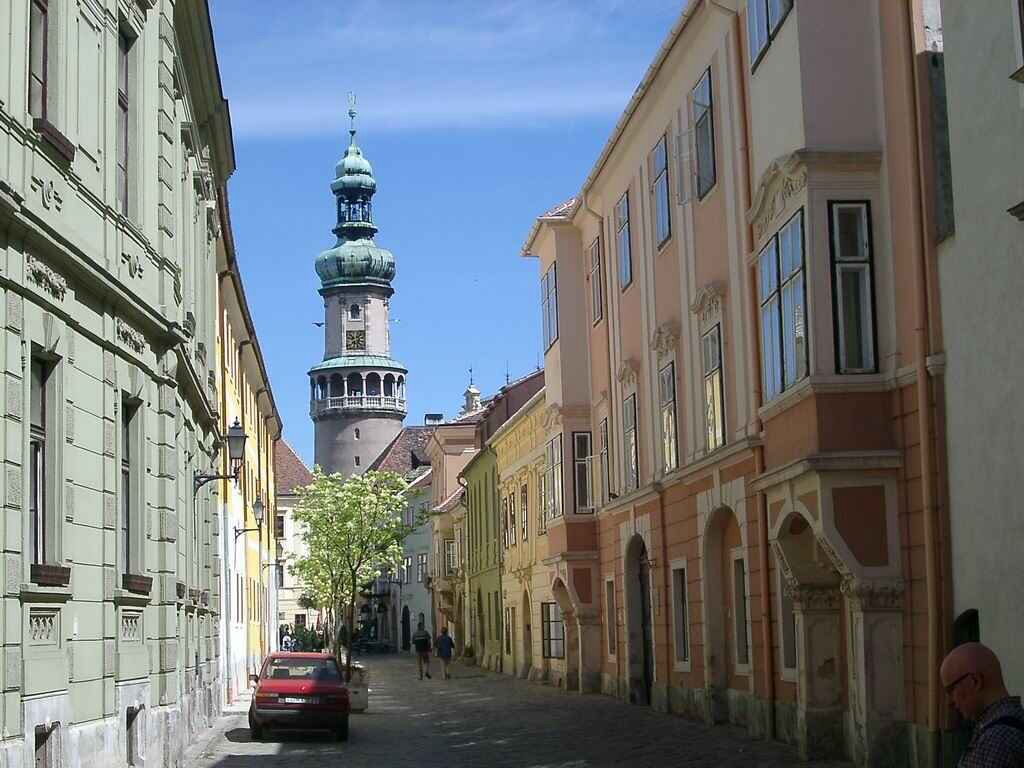
The lozenge-shaped heart of the town is a disorientating labyrinth because you can only see a short distance in front of you; it’s the best preserved Medieval centre I’ve seen this year (Kosice, Eger, Krakow being the others). Rounding one corner, we chanced upon the postcard image of the Fire Tower, its pillared loggia and onion dome bathed in misty sunlight reminiscent of high summer, even though it was hat-and-scarf weather.

On the streets we passed elaborate lamp-posts whose blackened wrought iron was fashioned into flowers and leaves. The houses are never regular, perhaps because the gothic and baroque facades have been built over wattle and daub or stone walls. In one alleyway, brick arches propped up two converging buildings, which might otherwise have collapsed. We saw top floors jutting out over the street and a blind window with an intact stone cruciform frame and signs of much older buildings in the marzipan-toned walls. One boasted a somnolent-looking weather-beaten lion’s face and others had arrow-slit windows.

The best bit about roaming is that there are a lot of side alleys to dart down. This is because every second or third house has a large arch to admit coaches, and some have the lower barrel-vaulting of cloisters. The doors were often open; you could stray into courtyards where flowers cascaded over tiny balconies. Inside one of them, it looked like a witch’s cottage overlooking a walled garden. We also ventured into one with nothing but a solitary tree at its centre. My friend said she felt that it was the kind of place where someone’s life might have been irrevocably changed by a piece of music. When we left, a plaque told us that Liszt Ferenc had in fact given a recital there once.

In one of the baroque churches, almost completely deserted, a solitary organist was playing Barber's Adagio for Strings. The contrast couldn't have been greater between the unbearably delicate melody and the unwieldy baroque decoration dripping from the walls.

Behind the buildings, you could discover a whole geometry of little pathways, wooden bridges and ramps running parallel to the city walls built on Roman foundations. The chilly mist and the autumnal light merged magically. This was when the first bell of midday clanged its way into our thoughts, soon to be joined by a chorus of others.

Monday, October 31, 2005

HALLOWE'EN PAST

Today is Hallowe’en, the ancient European festival of Samhain, “summer’s end”, which was the most magically potent time of year, and even, it has been suggested, New Year. This was the night when the autumn fires would burn to provide, according to the Celtic Spirit website, “an island of light within the oncoming tide of winter darkness, keeping away cold, discomfort, and evil spirits long before electricity illumined our nights”. People would take a part of the fire to re-light their own hearths; in some parts of Scotland this custom apparently continued up till the First World War, the time when so many folk traditions were extinguished.

These popular so-called “Celtic” sources (though this is something of a misnomer) often tell us that at Samhain the “veil between the worlds” was at its thinnest; I have always liked this image as it makes me think of a cacophonous crowd of mischievous sprites and daemons pushing this nebulous membrane so that the tiniest rent could quickly become a rift that would send them tumbling through into our suburban streets. Of course, in the old tradition, the veil was one between the living and the dead. It was above all a festival of the ancestors, and hence its modern incarnation as a night teeming with ghostly nasties. Finally, Samhain also marked the end of the harvest; all the remaining crops in the fields were thenceforth subject to the malign influence of faeries and, being thus accursed, must not be gathered.

In my own little Scottish village, we had traditions of our own. I used to go “guising” as a child, which was a real thrill, given that I did not normally go out at night for any reason. Dressed up fairly carelessly, usually as Tom Baker-era Doctor Who, although I may have had one or two other guises, I ventured forth clutching my nightlight-in-a-jar lantern, which inevitably went out with the first serious gust of wind. (I never actually had a turnip lantern until a friend of mine made one when I was in my thirties.) I remember other costumes being really inventive – in particular, my best friend Alan’s parents would go to great efforts, and one year he was “Mr Music”, clad head to toe in a paper suit and hat patterned with real musical scores. We all had a little routine to do to earn nuts, sweets and coins from the neighbours: this would consist of a song, a poem, jokes, etc. We went to some lengths to learn these by heart. One of my neighbours, an elderly woman with no children, was exceptionally generous. She always stockpiled a mound of goodies, including homemade toffee, and as her reputation spread, children came from far and wide to knock on her door. Eventually, she’d run out of stuff and have no option but to put the lights out and sit in silence to end the siege.

This all sounds so quaint now, like something from between the wars, even though it was in the 1970s! There was no “trick-or-treat”-ing then; this was a later American import. Above all, we all felt safe to roam the streets unaccompanied, which was the real treat. It’s not just ancient customs that have been consigned to the grave.

Sunday, October 30, 2005


LAST NIGHT AT TUZRAKTAR

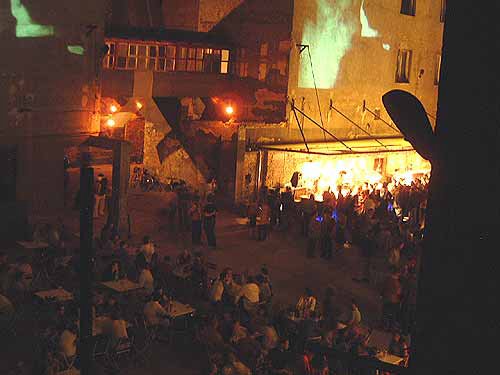
It was cold, much colder than we had expected it to be when we arrived at Tuzraktar to see if the rumours were true that it was going to be burned down by the mafia. An abandoned commercial building inhabited by various artists and performers, it’d been our regular Sunday night hang-out ever since we heard about the leftfield films (Derek Jarman, David Cronenberg) they were showing. You didn't just get the films (watched from old armchairs and sofas), but peanuts and Coke too. All for free.

The metal mesh gates are flanked by two giant boilers, each bearing a paraffin torch. These are typical of the post-industrial medieval atmosphere which pervades the central open space. Eerie, hastily executed images in white decorate the concrete walls: grinning monkeys, clowns, a woman on her hands and knees, a series of stencilled goats. Random household objects dangle from the unglazed windows. At the far left, there’s a small tree growing out from the outside of the third floor.

Tonight parts of the walls are red-lit, and there are paper and cloth festival lanterns hanging in a row between the buildings. They are lurid: faces, flowers, storybook animals and abstract shapes. Behind the bar are some fluorescent cartoon aliens and mushrooms on an overhead canvas. And in the centre, three barrels of fire with people clustered round feeding them broken bits of furniture. Every so often, the embers take on a life of their own, splutter and tumble out, making us all jump back in alarm and delight. There's the acrid, always autumnal, smell of woodsmoke. A girl is roasting lard and onions on skewers over the fire to make bread and dripping. All of this is bathed by cut-out snowflake and flower images cast in magenta and orange by a revolving disco light.

Down in the cellar, a local band is rehearsing some kind of French cabaret songs: the four singers, swinging their arms in sync, carry it off well even though they outnumber the audience. Upstairs, if you can brave the night air through the gaping window-spaces, you can see a collection of unusual paintings. The images are modern: vibrantly experimental, yet not abstract in any sense. The artists’ sincerity is clear in every work.

I hope this place reopens in the Spring. This kind of unmediated freedom of expression can only exist in the gap between post-industrial abandonment and near-inevitable enguzzlement by property developers. Let’s hope we beat them to it again.

SCRAMBLED - song lyrics

I'm losing the thread of thoughts in my head
Caught sight of oblivion - my old languages are dead
And I won't wait my turn while this city is burning
Caught sight of oblivion in the crap I'm supposed to learn.
The future is here but we're not in control
Better hold on to your soul.

I'm coming unstuck, I can't reconstruct
A thousand scrambled channels - my old languages are fucked
And that's just the start. What's happened to my heart?
A thousand scrambled channels and the feeling just won't start.
The future is here but we're not in control
Better hold on to your soul.

My brain is so tired, the neurons still firing
A thousand scrambled channels - my old language is retired
The network's still up but the files are corrupt
A thousand scrambled channels then the audience erupts
The future is here but we're not in control
Better hold tight on to your soul.

Saturday, October 29, 2005


TOO MUCH PROPERTY IS THEFT

Private landlords are getting fat from the misery of others who can't afford to buy a home, while draining away the little money their tenants have worked for. I suggest the law in the EU be changed to restrict each household to one mortgage. It is quite enough. (The definition of "household" would have to be carefully worked out to prevent fat cats buying property in other people's names.) Households with excessive properties would be required to put these on the market by the end of the financial year, and eventually this would be extended to include any household with more than one. I think this would bring about a generaly beneficial readjustment in the property market.

Thursday, October 27, 2005


WHILE ROME BURNS

OK, it's another testosterone-fuelled rant into the depths of virtual space.

It's the hottest October 27th on record in the UK, and, conveniently for the Six o'clock News, it's the same day Prince Charles is telling us to move global warming up the political agenda. At least someone in public life is aware enough of the issues, and able, because of not being beholden to any electorate, to speak out. It might even be a reason to hold on to the royals?

But what really matters as our civilisation teeters on the brink of collapse?

And now here's Gary with the sport. Who'll be the new (insert football team) manager/ centre-forward?
Now you can hear the new release from (insert talentless babe or heart-on-sleeve whining falsetto)
10 hot tips on how to improve your sex life
The Top Ten (insert - usually - inane junk) Ever Made
Vote for the top Dad - Ozzy Osbourne or Homer Simpson
Why x has split up with y
The Nikkei. The Hang Seng. The Dow Jones. The Footsie.
Is it better to have a big tum or a big bum?
Which overprivileged unthinking careerist nincompoop will lead the Tory Party??? Ha ha ha ha.
Neo-medieval feuds over different conceptions of a FICTIONAL Middle-Eastern God
and, can you believe it, the other day someone invested $150,000 in a virtual space station that's part of some online game!

(At least the naked power interests fighting the "war on terror" are doing something relevant in their attempt to do down the other part of humanity and gain strategic control of the reserves of the power source we seem to be addicted to.)

It could almost be funny and if I'd drunk a couple of pints, it probably would be. This is one of the reasons to drink, after all.


We tuck into junk food and are spammed by people's junk thoughts. All day long. Anything of any worth at all, like Prince Charles's comments, will be derided or, at best, ignored. Welcome to the end of the world. And heralded neither by a bang nor a whimper, but a fizz. It's the cacophony of a million distractions and digital cables carrying nasty, corporate-funded trivia to infect us all. The sound of the approaching hurricane is nearly drowned by it. (See below)

Saturday, October 22, 2005

BRING ON THE STORM - song lyrics.


Just my luck - caught out in the storm
Blow through me now, blow my house down.
Take my stuff, sweep it up
Into the winds and all the wildness.
Take my day, mess it up
Stop the play, close the circus;
I want to feel what it's like
Without a shield and in the open night

Bring it on, the noise and the light
Bring it on, the wind and the wildness
Bring it on, the noise and the light
Here's my life:
Blow it to pieces.

Take our town, break it down
I don't care now - don't really live there.
All the long muffled days
The land is cracked and ripe for rain.
Take the lights, switch them off
Close the bars, and the arcades;
Close the school, stop the clocks,
No more guile in the time we've still got.

Bring it on, the noise and the light
Bring it on, the wind and the wildness
Bring it on, the noise and the light
Here's my life:
Blow it to pieces.

Sunday, October 09, 2005

BAND OF GYPSIES

Giero, just off Liszt Ferenc Ter, is one of Budapest’s many cellar bars. It’s cramped and with a constant pall of smoke and you can’t hear anything except the music. On Friday, just as on every night, its barrel-shaped structure reverberated with the soaring and frenzied sound of the Roma (gypsy) house band, and we were seeing them for the first time.

There were five or six musicians of varying ages and we were told that they play in shifting combinations; it seems as if anyone from their number can just turn up and join in. So in this way it’s like a traditional Irish session, but the similarity ends there. For in this band were not one but three players of such virtuosity that it set them apart from any run of the mill folkies, and they might easily have been performing in far less humble surroundings.

Leading the band tonight was a guest fiddler, a stocky bespectacled gent in his fifties. He was a consummate showman and reminded me of a figure from Death in Venice (or Mario’s magician?) in the way that he peered over his glasses at each guest, cajoling them, drawing them out of themselves, and not letting go until he got complete involvement: smiles, nods, or raucous singing along. He strutted up and down between the tables, exuding a simmering sensuality, completely at odds with his age, but which he was obviously unwilling to contain. His scratchy notes sprang out, endlessly playful and unpredictable, teasing the main melody, keeping you hooked.

No doubt slightly annoyed to be under this man’s shadow was the usual lead fiddler, a wiry Casanova with sculpted cheekbones like someone from a 1940’s film. This man intently serenaded the women with poignant and lyrical phrases, all the time fixing them with a gaze that could have scorched their skins, as their men shifted uneasily in their chairs. With his instrument thrust under his chin, he adopted a variety of theatrical poses as part of his game. Every now and then he would stop and give a little bow.

Presiding over all this was the Buddha-like cimbalom player enthroned behind his instrument. (This looks something like a small wooden grand piano, and has several different sets of strings, which are hit with beaters.) His presence conferred an air of benevolence to the whole ensemble. He threw a series of amiable glances around the room, quite clearly delighted with his apparently haphazard genius. Moving his arms back and forwards piston-like, he beat out rhythmic patterns with superhuman speed and precision. The slightly out-of-tune cimbalom responded with streams of soft, slightly muffled notes like a silent movie score, or an old music box.

The searingly intense melodies themselves, built from exotic scales, rebounded from the walls and enveloped everyone. They spoke eloquently of another century and a different way of life which these people still live.

Saturday, September 10, 2005

LESS IS MORE

I've had my laptop computer for just over a year now, and as a reult have amassed a good collection of MP3 music files, something like 12 days' worth of music. It's common now to be walking around with double this quantity. This summer on a long train journey, I had fun skipping through tracks on my friend's iPod. While I enjoyed listening to parts of tracks by a whole lot of bands I'd never heard before, something remained dissatisfying - few of the tracks held my attention long enough for me to stick around for the few minutes until the end. There was no reason to, since there were so many thousands of others to skip to. I was mildly entertained for a while, then I got my book out instead.

Yesterday, I took my clunky old CD Walkman to work - it was given as a present to me about 10 years ago. And I was listening to clunky old While My Guitar Gently Weeps from The Beatles 1967-70. I was immediately arrested and transfixed by the agility and inventiveness of Paul McCartney's slightly abrasive sounding bass line in the right earphone, which sets off the main melody to perfection. The sound quality, while nothing like vinyl, or even a "real" CD player, is magnificent after a diet of thin compressed digi-gruel. The sounds are bright, vibrant, chunkily defined. I felt sad to remove the headphones as I arrived at work.

Don't believe the hype. The experience of losing yourself in music is about one thing only - sound quality. (And a few albums you love to listen to.)

Sunday, August 28, 2005

WATERMELONS: A PERFECT PLEASURE

I am not very well acquainted with melons, having been raised on a humdrum diet of apples, oranges and bananas. I remember having one or two at friends’ houses, but they never made much impression with their slimy texture and insipid sweetness. As an adult, I never bothered to buy any - until recently. Here in Budapest, heaps of watermelons are piled up outside small grocery shops like cartoon cannonballs. They’re cheaper than water, but incredibly heavy and need to be lugged home separately from any other shopping. There’s no room in the bag for anything else.

Here’s how to eat a watermelon. It’s best enjoyed chilled – this is important - after a tiring day at work, or for breakfast, or having returned from a drinking session, or in the middle of a hot afternoon. Stick a knife into its impressive bulk and cut right through the soft flesh. Then, when it is almost cloven in two, grab the halves and pull them apart with a satisfying crack. Admire the flesh, a perfluence of glowing deep pink incandescent with runny sweetness and glistening like the surface of an iceberg. It’s scattered with jet black seeds.

Repeat procedure until you have a large segment. Then cut round the edge of the pink area, prising the gorgeous fruit away from the skin. And cut into chunks. They’re almost opaque when held to the light. You can imagine the individual crystalline cells. The anticipation is a delight.

Now, plunge in and feel the juices break over your chin, running down and dripping on to the table/ your feet. Deliciously crunchy like a sorbet on first contact, the fruit then collapses on your tongue, bursting into a cool flood which gushes down your grateful throat. For a few minutes you dissolve in a frenzy. It gets a real mauling, and soon you are whimpering with pleasure, and replete with a distended belly.

Saturday, August 20, 2005

ETHICS AFTER NIETZSCHE: SOME THOUGHTS ON NATURE, CHARACTER, VIRTUE

This was originally posted on a Nietzsche discussion group.

How fixed are our natures? Is there such a thing as a universal “human nature”? Are our natures conditioned more by genetics or the environment? On the other hand, are they at all malleable? Can we work with them as at a potter’s mould? Can we "become what we are"? Does this art of overcoming become more difficult as we get older, as suggested below? When, if at all, do we lose the skill?

The ideas below are tentative, and derivative. I offer them for comment.

I am fairly convinced by the "hardwired" school of evolutionary psychology; we are born with certain capacities and limitations. This I call our individual nature. Then the individual's early upbringing and family environment triggers/activates certain capacities while others are left dormant, yet not atrophied. I call the resulting product (or rather, "climate" - see last post) our character. I suspect that we can change our characters very little after adolescence, and only by degrees, but there is probably individual variation in this.

As part of their characters, some individuals have a stronger tendency to suppress their basic drives, and conform. All men (& women?) have to do this to some extent - i.e. suppress the most violent drives - to exist within society. Whether we tend to resist or conform, it is all utterly deterministic. Different social circumstances vary the the opportunity for pre-existing elements of our characters to be expressed; this is why we appear to change as we move from place to place, geographically or in a hierarchy. The appearance is greater than the reality of the underlying change, although of course new behaviour can become habitual.

Often, and more often than not in the truly great and the criminally insane, the basic drives run contrary to external pressures; we call this Will. Our ethical systems - after Nietzsche, “fragments” would be a better word - were socially evolved systems of drive-suppression, conditioning by means of sticks and carrots. Incredibly useful to have in society, but the stronger-Willed sceptics, as well as the merely cynical, have always been able to reinterpret, reinvent or else junk them to suit themselves. The weaker-Willed castigate themselves for not following these dictates; as Nietzsche pointed out, guilt is indeed one of their strongest feelings, the characteristic manifestation of drives suppressed.

"One must follow the instincts, but persuade reason to aid them with good arguments." Beyond Good And Evil, 191

Within this post-Nietzschean world, it is still possible to construct a system of virtues, although the final ones individuals choose to aspire to, and teach their children, need not be Nietzschean ones! To be credible, they do need to be rooted in a good grasp of evolutionary psychology.

Compassion is arguably a virtue, though it was utterly contemptible to the Nietzsche we find in print. (Perhaps not in all cases. He was marvellously inconsistent. And where's the virtue in consistency?)

Monday, July 18, 2005

HARDWIRED

“ Success (or failure) in matters of love, money, reputation or power is transient stuff; you soon settle back down (or up) to the level of happiness you were born with genetically.” In Tom Wolfe's Hooking Up

Wolfe predicts that a new Nietzsche will soon come to announce “the Soul (or Self) is dead.” The suspected killer is the neuroscientific world view, which aspires to explain away these entities, along with another old friend, free will. Scientists claim to have discovered that most of the behaviour that makes up our cherished view of ourselves is in fact genetically encoded, infamous examples being intelligence, homosexuality, having criminal tendencies, and how we respond to beauty.

This will bring about a sea change in our thinking, claims Wolfe, as we have long been used to ideas of social or psychological conditioning – from Marx and Freud, respectively. The result could be that many of our everyday notions become quaint artefacts. Personal responsibility is the most important of these, and along with that goes the ability to criticise meaningfully the actions of others.

I doubt the change in the intellectual climate will be so profound.

(1) There is as much evasion of responsibility in saying “I’m socially conditioned – don’t blame me” as in saying “I’m wired wrong – don’t blame me”.
(2) When we praise or blame, for moral wrongdoing (e.g. “Blair was wrong to go to war”) we are not thinking of some absolute freedom of choice at the moment of decision, as if the culprit had flicked the wrong switch. (This kind of existential pause before decisionmaking is, in any case, the exception rather than the rule.) Rather, we are thinking of someone’s whole character that formed the background to the choice made. Blaming someone is like blaming a faulty computer. It doesn’t matter exactly how the fault came about; the point is that it is there now, and worth complaining about, or taking action over.

As for the Soul (or self) being dead, this is old news to Buddhists, readers of Proust, and many philosophers. Don't be too hard on yourself, because you, as a discrete entity, literally don't exist. The notion of your slowly changing and evolving character is preserved, however - it is something akin to a climate. Get used to acting as a collection of events, and seeing statements about you and your personal beliefs in the same category as weather reports - reasonably reliable, but not facts. Your moods are like tropical storms. And if things aren't going your way, wait for a change in the weather.

Sunday, July 17, 2005

RAW FOOD SUBVERSIVE

"The ethical value of uncooked food is incomparable. Economically this food has possibilities which no cooked food can have." Gandhi.

Raw and "bio" food seems to be taking off here in Central Europe, but I suppose it never came down to earth, as it were, in a culture where "total wellness" has long been touted as a panacea to the great Hungarian cholesterol-gobbling masses. The more usual diet of sausages, fried dough and multifarious cheeses sadly leaves droves of people hobbling before their time.

Headed off to the country recently for a weekend of eating raw food, doing yoga and general abstinence. Our hosts were a rake-thin couple in their sixties, who had evidently been at it for years. They prepared exquisite dishes from various vegetables, fruit, seeds and nuts - not just salads but tasty main courses, spreads for toast and even cream cakes (with nut cream.) I certainly felt rejuvenated after eating this stuff for two days, though this may have been as much to do with not having had a drink all weekend (something I don't do, unless ill) as anything else.

On the down side, there wasn't a lot of humour to be had during the weekend. All the participants were very earnest; good people, but of the po-faced fanatical type, and scarcely a giggle escaped their lips. I've noticed this is a marked tendency among the spiritual and people from a broadly Left tradition, and I'm not sure why. I think it's because "enlightenment" tends to dispel lightness, and humour to subvert.

Joan was utterly dominating, and presided thin-lipped over the proceedings. Before each meal, she declared, after waiting grimly for silence to descend, that she would talk about the food, and this she proceeded to do in hushed reverential tones. The first time, we wolfishly lunged at the great mounds of food, so her tremulous husband pre-empted us the second time: "in this house, it is customary to spend a few seconds in silence." We felt suitably admonished.

Among many edicts and prescriptions, Joan said you should eat nothing with a watermelon, and no more than eight dates at a time. Also, water should be drunk no less than half an hour before eating, NEVER with the meal or afterwards as it would wash away all the enzymes before they got to work. So when I went upstairs to get a little of my water (wisely packed) I felt a Class A twinge of guilt. I plucked up the courage to bring the plastic bottle into the yoga room later; it earned a withering glance from my teacher, the kind relapsing alcoholics get from their counsellors. When Judit, my girlfriend, brought some plates and leftover food to the kitchen, she was stopped from putting it in the bin with Joan's terse proclamation, "I have special rules for leftover food!" (It was to be further empulped for one of the next day's spread.)

All the discussion was about food, food, food. In a moment of snatched privacy, Judit said, "you'd have to be in your dotage to be so preoccupied with your digestive system." We had to escape for walks a couple of times - and we felt as if we were skipping off school! When her husband started going on about some disciple of Hungary's original raw food guru - possibly a former Nazi, I thought - who was alive at 96, I thought of my grandmother going strong at 91 on her own particular regime of sweets and cream cakes.

Saturday, July 16, 2005

THE HYPNOTISM OF WASPS

When I used to live in Ghana, I had a wasps' nest somewhere near my house, perhaps even under the rafters, and, since I had left my radio in bed under the mosquito net, my breakfast time entertainment was to study their behaviour. I observed a strange ritual that I can't explain.

The noise of the wasps all buzzing together would begin soon after I turned the light on, and sometimes they were up before me. Collectively, they generated a deep high-voltage hum like you would get from a faulty electrical appliance. They would always gather on the grille of the windows because the brightest light usually came from here. Like a schoolboy, I'd extinguish this light and switch on the external one, listening to the immediate pitch change when I did so. Of course, they'd gradually migrate to the other bulb, although it took some of them quite a long time to realise the light source had changed. Perhaps they were sleepy like me.

By now, the sun was starting to come up over the bush land beyond the campus. At one point, just at the moment you'd describe as daybreak, when the light was enough to give some colour to the sky, the wasps stopped dead. This wasn't sudden enough to make you sit up and notice; it happened over a minute or two. There they would sit, frozen in awe (as it seemed) or else complete confusion. All buzzing ceased. And the stillness continued for about twenty minutes, after which they began to fly off, individually and randomly. The first time I saw this conglomeration, I actually thought they had all died during the night. It was spectacular in its own way.

What was going on? Were they greeting the dawn, passing chemical messages to each other in mute communion, or simply trying to calculate the position of the real sun? In their eerie unison, I couldn't help but notice the similarity with the other call to prayer which was happening a little further away on campus, every day at the same time.

Tuesday, July 05, 2005

LIVE 8: HOW WE ARE ALL BEING BETRAYED

Behind all the supposed well-wishing for Africa, Western companies are lining up to exploit the continent. The increases in aid will have strings attached. There will be no real movement on fair trade. An economic protectorate is being created, rather than giving Africans a say in their own future. Please copy and paste this link into your browser, and someone tell Bob Geldof.

http://www.guardian.co.uk/Columnists/Column/0,5673,1521411,00.html

Wednesday, June 29, 2005


AGAINST CYNICAL HACKS - MAKE POVERTY HISTORY

A colleague at work told me that he had read a review of the Glastonbury festival that said no one really knew what Bob Geldof was on about when he tried to rally the crowd. He asked me why Geldof pops up once every twenty years to rant on about Africa. I also read a comment on the BBC site about his having an inflated ego, etc.

Stop!

Here is a man who has often campaigned on poverty-related issues. It doesn't often hit the big headlines because it doesn't involve Live 8 type events. (Incidentally, he had to be begged to do this one. Itisn't a publicity stunt.) He has, as far as I know, visited the continent on many occasions. What I know for certain is that he was a member of The Commission for Africa, a UK governmental body which was set up to look into all these issues and into what the developed (read "rich")world could do to help solve some of the continent's woes.

Commission for Africa site:
http://commissionforafrica.org/index.html

Geldof knows his stuff. As for his oratory skills, that's a matter of opinion. I like him because he talks straight. In the middle of millions of messages broadcast across the planet every day, he is saying the things that need, desperately, to be said. OK, words are just words, I know. But Geldof is doing more than any other human being on the planet to raise awareness this year. And awareness is where it's at. As far as I know, the hip Glasto crowd responded well. Some people cried. A lot of the audience will have been following the campaign from the beginning of the year.

http://news.bbc.co.uk/2/hi/entertainment/4620635.stm

As for the timing, this year is a once in a generation chance to make a huge impact on global poverty. The reason is to do with a unique coincidence of events. The UK government, which is more progressive on these issues than most governments, is hosting the G8 summit in Gleneagles. The summit has development on its agenda, and comes quickly on the heels of the tsunami disaster, which motivated millions to give an unprecedented amount of money. So, the argument goes, with this amount of popular awareness coinciding with this political event, the opportunities for change are immense. And won't come again soon.

The Make Poverty History campaign aims to:
- double aid
- cancel all debts
- bring about fairer trade rules

If trade rules can be altered (getting rid of subsidies to rich countries, letting developing countries have a degree of protection for their markets...) or, at the very least, aid was not conditional on these countries' having to implement unsuitable economic policies (privatising their essential services, etc), then we wouldn't have to have the level of poverty that we put up with.

Of course, Bush has already watered everything right down and the politicos are doing their usual fudging. So the show will go on as usual...

Except that this time, there's a crucial difference. Because of Live 8 (which will be a culmination of the growth in awareness of these issues since the original Live Aid) THE WHOLE WORLD IS WATCHING. And if these bastards do not heed the million people on the streets, we can take one clear message away from it: democracy is a sick plant. People have been coming to realise this, but it will never have been hammered home so starkly.

1968 nothing. Welcome to 2005. Go to the Live 8 site and sign the petition.

Saturday, February 19, 2005

NO SATANIC POWER IS IN CHARGE

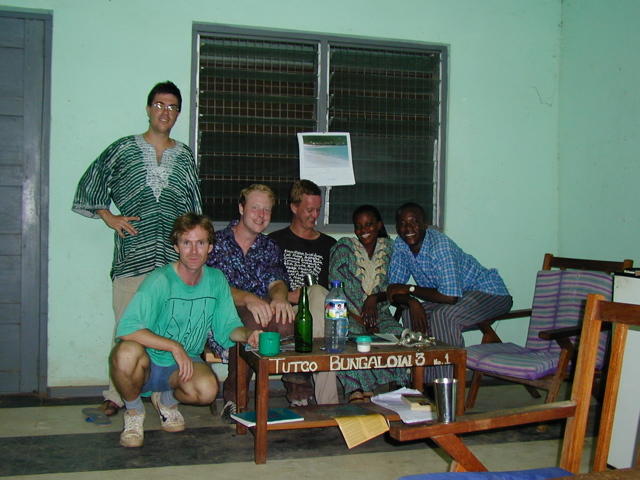
This is a rather catchy shop (actually just a roadside kiosk) name I remember from when I lived in Ghana in the late 1990s. I was recently sent a link to the site of Trevor, a Peace Corps volunteer who worked in the same town as I did, a dusty but wonderful backwater called Tumu in the Upper West region. Seeing the photos again nearly broke my heart as I miss those days so much. (Funny that, in my last months there, I was crossing the days off the calendar... See my entry on sleepwalking.)

Trevor also did a good job of collecting the shop names below, which are all genuine. I'm not sure whether the idea is to have God's blessing on the business, or whether these were just dreamt up in fits of fervour? I love the typically African juxtaposition of the spiritual and the absolutely mundane.

Bride of Christ Aluminium Works
In God We Trust Fast Food
My God Is Able Plumbing Works
God Did It All Fashion Centre
Anointed Fashion
In Step with the Spirit Enterprises
Anointed Hands Furniture Works
I Can Do All Through Christ Strengthened Me Fashions
Blood of Jesus Electricals
Lord Is My Shepherd Hotel
God Will Provide Supermarket
God's Time Barbering Shop
Jesus Is Evergreen Enterprises
God First Carwash
God Bless You Modern Fashions
Lord J Clinic

The photos are here:

  • Trevor’s Peace corps site
  • Wednesday, February 16, 2005

    INSPIRED?

    I came across this thought-provoking idea on a website about plants, amongst other things. It's a proposal for a new religion.

    http://deoxy.org/t_ppp.htm

    "A non-theistic mythology that inspires awe in the mysterious, reveals cosmology through science, provides social cooperation in the form of compassion and a pedagogical foundation is indeed the natural course of our development. Obviously, the myth must be simple in its minimalist form, imaginative and yet profoundly sublime."

    While I don't agree it's "the natural course...", I do think the writer has made the important points about the things a post-religious society lacks. What could such a new myth consist of? Could it ever be designed, or must it just grow? Or is the whole idea misplaced?

    Tuesday, February 08, 2005

    HOW SLEEPWALKING CAME TO BE SO PAINFUL

    The essentials were hatched by two of a little coven of devils working under a distant hill, moulding the fate of men from the base metal of their dark kingdom. Crouched in a hole, warming his claws against the licking flames, Verhanorath first had the idea:

    “Let’s fill their idle hours with longing for the things that were and the things that can never be!”

    “And let’s make sure their wisest books tell them in grave and inky words to live in the eternal moment…” added Septeroth, his green eyes glinting. “They’ll want to work on this, but we’ll make it tedious and time-consuming to master.”

    “And useless,” chuckled the first, “for these fully lived days will be as spent matches to them. Not so the days they sleepwalk through: rainy October evenings, attentive lovers not appreciated, idle pavement strolls in early summer, hated lessons at school, bus journeys on streets so familiar that they've long ceased to make any impression… these are the ones that shall sting their drab hearts ever after! And they'll be counted in years."

    He rubbed his talons – click click - in quiet mirth, but Septeroth looked uncertainly at the flame-lit walls and wondered if they dared let such a thing loose.

    Sunday, January 30, 2005

    MINUS 11

    This is the coldest weather so far. For Hungarians, it's very moderate - many of them are walking round without hats. It's the kind of icy cold that sends draughts seeping through hats anyway, and scarves, and layers, so that you feel your body stiffen and draw back. But there's absolutely no refuge from it. Until you come back indoors to the amazing blast of uncontrolled communist-era centrally heated blocks.

    How hellish to be sleeping on the streets tonight, and there are some who do - under shelters of scaffolding, with dirty old quilts and mattresses made from cardboard boxes. Shame on any society that can let its old men shiver and, in some cases, die in pathetic berths like these.